Nha Trang vs Da Nang vs Phu Quoc: Which Beach for Which Month
The three have rainy seasons that barely overlap: Phu Quoc is dry while central Vietnam is wet, and the other way round. If you are weighing Nha Trang or Da Nang, or the longer flight to Phu Quoc, start with the month you can travel.
Written by Tụi mình mê biểnPublished Updated

Photo: Quân Chu Hoàng · CC BY 2.0 · Wikimedia Commons
In November, when Nha Trang is getting its heaviest rain of the year and Da Nang is still in its storm season, Phu Quoc is drying out and the sun is back on the beaches along the island's west coast. Six months later it flips. In June and July, Tran Phu beach in Nha Trang and My Khe in Da Nang are sunny and flat from morning to late afternoon, while Phu Quoc is in its southwest monsoon, with one shower rolling in after another.
Because the wet seasons are staggered like this, the quickest way to settle Nha Trang or Da Nang, or the longer flight to Phu Quoc, is to start with your travel dates. Only then does the kind of trip come in: small children, a couple's break, a food-and-street trip, or days on boats and reefs.
Three rainy seasons that barely overlap #
Two monsoons explain it. From roughly May to September, the southwest wind blows across the Gulf of Thailand onto Phu Quoc's west coast and brings most of the island's yearly rain. At the same time, the central coast sits in the lee of the Truong Son mountains, so it gets long sunny days and a calm sea.
Late in the year the wind swings round to the north and northeast. Now the central coast takes the rain off the sea and Phu Quoc goes into its dry season. Da Nang is further north, so its rain starts earlier, falls harder and lasts longer than Nha Trang's. Da Nang usually peaks in October, Nha Trang in November.
Winter temperatures pull apart too. In January, Da Nang reaches only about 24°C (75°F) by day and drops to around 20°C (68°F) at night. Nha Trang runs a couple of degrees warmer, and Phu Quoc still hits 29°C (84°F), as it does in midsummer. If a proper swim is the point of a December to February trip, that gap matters.
Nha Trang or Da Nang or Phu Quoc: a month-by-month table #
The table compares average monthly rainfall and the number of days with at least 1 mm (0.04 in), worked out the same way for all three places. A "rain day" includes a short shower, so read the rainfall first and the day count second.
| Month | Nha Trang | Da Nang | Phu Quoc | Best bet |
|---|---|---|---|---|
| Jan | 85 mm, 14 days | 170 mm, 20 days | 62 mm, 11 days | Phu Quoc |
| Feb | 50 mm, 9 days | 78 mm, 13 days | 40 mm, 10 days | Phu Quoc, Nha Trang |
| Mar | 40 mm, 9 days | 52 mm, 10 days | 58 mm, 14 days | All three |
| Apr | 54 mm, 10 days | 75 mm, 8 days | 136 mm, 20 days | Nha Trang, Da Nang |
| May | 89 mm, 15 days | 73 mm, 13 days | 344 mm, 27 days | Nha Trang, Da Nang |
| Jun | 76 mm, 12 days | 66 mm, 10 days | 376 mm, 28 days | Nha Trang, Da Nang |
| Jul | 102 mm, 17 days | 118 mm, 16 days | 467 mm, 30 days | Nha Trang, Da Nang |
| Aug | 112 mm, 16 days | 116 mm, 17 days | 410 mm, 30 days | Nha Trang, Da Nang |
| Sep | 173 mm, 21 days | 242 mm, 22 days | 501 mm, 29 days | Nha Trang |
| Oct | 260 mm, 26 days | 467 mm, 26 days | 407 mm, 28 days | Nha Trang, with flexible plans |
| Nov | 370 mm, 23 days | 346 mm, 24 days | 179 mm, 20 days | Phu Quoc, second half |
| Dec | 232 mm, 19 days | 346 mm, 25 days | 69 mm, 12 days | Phu Quoc |
February to April is the easy window. Nha Trang and Phu Quoc are both dry, and Da Nang warms up from March. It is also the best time to split a trip between two of them, because the weather works with almost any combination.
In summer, Nha Trang and Da Nang are close to a tie: sunshine, a calm sea and rain mostly in late-afternoon storms. June and July are also Vietnam's domestic holiday peak, so book rooms and flights early. Phu Quoc gets a lot of rain in these months, but it tends to come as short tropical downpours between sunny spells, and the island is quieter than in the dry season.
September tips toward Nha Trang. Rain has picked up, but the sea is usually still calm, while Da Nang is starting its heavy-rain spells and Phu Quoc is at the peak of its wet season.
No option is truly dry in October and November. Nha Trang gets rain on many October days but few very heavy ones; November is the real peak. If you are going then, plan around the rainy spells as described for October and November. Phu Quoc clears in the second half of November, when rainfall drops to about two-thirds of the first half.
In December and January, Phu Quoc is where you are most likely to get full beach days. Nha Trang has less rain by then but is in its windiest month of the year, and Da Nang is cool, with rain on many days.
How calm is the sea? Three coasts, three wind directions #
For a swimming holiday, waves matter as much as rain. Marine model data from the last few years shows summer as the calmest time in both Nha Trang and Da Nang, with the day's highest waves under 1 m (3 ft) on almost every day. From October, the surf builds earlier in Da Nang than in Nha Trang. By December both are in the northeast monsoon with bigger waves, and My Khe can have dangerous rip currents in winter.
Phu Quoc's west coast is the reverse: roughest from July to September, when the southwest wind blows straight onshore, and nearly flat for most of the dry season. In the rainy months, Sao Beach and Kem Beach in the south of the island still draw plenty of swimmers.

Photo: Prince Roy · CC BY 2.0 · Wikimedia Commons
Wherever you go, the beach flags and the lifeguards have the final say. Swim inside the buoyed areas, and stay on the sand when a red or black flag is up.
Choosing by the kind of trip #
When your dates work for two or three of them, the rest comes down to who is travelling with you and how you want to spend the days.
Families with young children
Nha Trang suits families who want everything close together: hotels across the road from the beach, and sections of Tran Phu beach set aside for swimmers, away from boats and water sports. VinWonders Nha Trang on Hon Tre Island can fill a whole day, and children's tickets go by height. For a gentler slope and smaller waves than in town, many families head to Doc Let, north of the city.
Da Nang works well if you want to add Hoi An's old town, which now sits inside Da Nang city after the 2025 provincial merger, for afternoons away from the beach. My Khe is calmest in summer. Phu Quoc suits a stay-at-the-resort holiday, especially in the dry season when the west coast is flat. The island's resort areas are spread out, so pick a base near what you plan to do.
Couples
Couples after a quiet break often lean toward Phu Quoc in the dry season, for west-coast sunsets and the white-sand beaches in the south. In Nha Trang, a day on Hon Tam Island or a few nights at the Bai Dai resorts near Cam Ranh airport give you something similar, with the city still there for dinner.
Da Nang is the pick for couples who want beach and town in equal measure: mornings at My Khe, afternoons in Hoi An, evenings along the Han River.
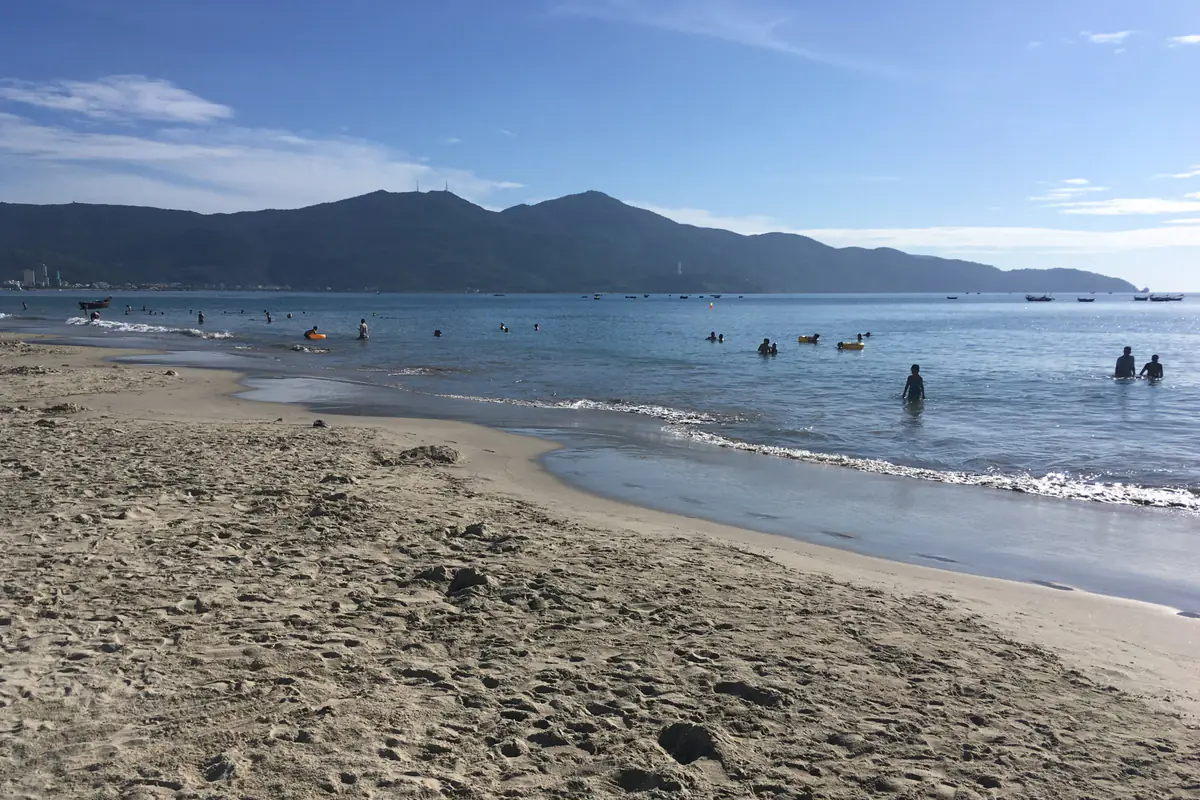
Photo: Christophe95 · CC BY-SA 4.0 · Wikimedia Commons
Food and street life
If the trip is really about eating and wandering, Nha Trang and Da Nang both beat an island. In Nha Trang the sea is right next to town: a morning swim off Tran Phu, a bowl of fish cake noodle soup on a plastic stool at lunch, then the Nha Trang night market and a seafood dinner by the water.
Da Nang is the bigger city, and Hoi An next door has its own Quang Nam dishes, such as mi Quang and cao lau. On Phu Quoc, dinner usually happens near wherever you are staying, because getting from one end of the island to the other takes a while.
Islands, snorkelling and diving
Nha Trang Bay has plenty of islands close to shore, with boats back the same day, so you can go island hopping and still sleep in town. Snorkelling and diving currently run only at four pilot sites, so before you book diving in Nha Trang, ask which site the operator uses. February to August is the best stretch for both. If you are not sure which island suits you, the island quiz gives a quick answer.
Phu Quoc has a cluster of small islands off its southern tip for dry-season snorkelling, plus the cable car out to Hon Thom. Da Nang is more about a city beach than islands; for diving, many people add a summer trip to Cu Lao Cham, off Hoi An.
Direct international flights and getting between the three #
All three have international airports. Cam Ranh, which serves Nha Trang, has nonstop flights from Seoul, Busan and other Korean cities, plus Almaty, Bangkok and Kuala Lumpur, and since September 23, 2026 a nonstop from Moscow. A Singapore nonstop is scheduled to start on December 11, 2026. The airport sits well south of the city, about 45 to 60 minutes by road, so factor that in when you plan how to get to Nha Trang.
Da Nang's airport is right in the city, with nonstop flights from Korea, Japan, Bangkok, Hong Kong, Kuala Lumpur and Singapore. Phu Quoc has had a daily nonstop from Singapore since late July 2026, alongside new routes this year to Taipei, Seoul and Hong Kong.
Combining two in one trip
Nha Trang and Phu Quoc are the easiest pair. Sun PhuQuoc Airways has flown nonstop between them since March 15, 2026, just over an hour in the air, four times a week at launch. Both are dry from January to April; in December you could spend a few days in Nha Trang for the city before moving on to the island for the beach.
Between Nha Trang and Da Nang, Vietnam Airlines flies Da Nang - Cam Ranh nonstop. If you are not in a hurry, the SE7 night train leaves Da Nang at 10:30 pm and gets into Nha Trang the next morning, which also saves a hotel night. March to August is the best window for pairing these two.
Da Nang and Phu Quoc have domestic nonstop flights; on days without one, connect through Ho Chi Minh City. Their dry seasons barely overlap, so this is the hardest pair to time, apart from March and April.
Is Nha Trang worth visiting? #
Yes, if you want a proper beach city: a swimming beach about 6 km (4 miles) long running the length of town, a bay full of islands you can reach in a day, and food from street stalls to seafood restaurants. For the days off the beach there are the Po Nagar Cham Towers, on a hill above the Cai River mouth, and an afternoon soaking in the hot mineral mud baths.

Photo: Rayrayokocha · CC BY 4.0 · Wikimedia Commons
Nha Trang is at its best for four or five days in the dry season, February to August, when you can swim or take a boat out on any day. For a first visit, the Nha Trang travel guide covers the decisions to make before you go, and things to do in Nha Trang lays out the sights in the order you would reach them.
It is a weaker fit if October or November are your only dates and you want to swim every day, or if you want an empty stretch of sand outside your room. In the first case, Phu Quoc from mid-November is the easier call. In the second, the Bai Dai resorts at Cam Ranh or an island in the bay will be closer to what you have in mind than the city centre.
If your dates are still flexible, the climate table in best time to visit Nha Trang helps you narrow it down to a particular week.
This year's rainy season: what the forecast says #
The seasonal outlook issued in mid-September 2026 by Vietnam's National Center for Hydro-Meteorological Forecasting puts El Niño at very strong levels. For October and November, rainfall along the central coast, including Da Nang and Khanh Hoa, is likely to come in 20-40% below the long-term average. Typhoons in the East Sea from October to December are forecast to be fewer than usual, and the rainy season in the far south may end early.
That is a trend for the whole region, not a promise about your week. A drier season can still bring a few very wet days. Check the forecast and warnings a few days before you travel; once you are in Nha Trang, the sea conditions tool shows the waves and wind for each part of the day.
How the numbers were worked out #
Rainfall, rain days and temperatures come from ERA5 reanalysis data via Open-Meteo, averaged over the ten years 2015-2024, for three grid cells: central Nha Trang, the My Khe coast in Da Nang and Duong Dong on Phu Quoc. A rain day is any day with 1 mm or more.
This is model data for an area a few tens of kilometres across, not a weather station, so it works best for comparing the three places. Wave heights come from the same provider's marine model, which only goes back to late 2021.
Nha Trang, Da Nang or Phu Quoc: common questions #
A few questions that come up when people weigh the three against each other.
Nha Trang or Da Nang: which is better?
It depends on the month. From February to August both are fairly dry with a calm sea, so choose by the kind of trip: Nha Trang has a bay full of islands and a beach right in town, Da Nang puts Hoi An within easy reach. In September and October Nha Trang usually gets less rain than Da Nang; in December and January Da Nang is cooler and wet on more days.
Nha Trang vs Phu Quoc in December: which is better for the beach?
Phu Quoc, usually. December averages about 69 mm (2.7 in) of rain there and the west coast is calm. Nha Trang averages about 232 mm (9.1 in) in December, its windiest and roughest month, which suits city walks, food and early-morning swims more than long beach days.
Is Nha Trang worth visiting in October?
It can be, with flexible plans. October is wet in all three places, but Nha Trang averages about 260 mm with few very heavy days, against about 467 mm in Da Nang, so if it is Nha Trang or Da Nang in October, Nha Trang is usually the drier choice. Expect rain on many days, keep the sea days loose and choose tickets and tours you can change.
Is Phu Quoc worth it in the rainy season?
You can go, as long as you accept showers on most days from May to October and a rougher west coast, especially from July to September. The rain usually comes in short bursts between sunny spells. If beach time is the priority in those months, Nha Trang or Da Nang is more likely to deliver.
Which is best with young children?
In summer, Nha Trang suits families who want a hotel by the sea, a beach with roped-off swimming areas and a day at VinWonders; Da Nang suits those who want to add Hoi An. From December to March, Phu Quoc is warm with a calm west coast, good for a resort-based holiday. Anywhere, keep children in life jackets on boats and in the water.
Can I combine Nha Trang with Phu Quoc or Da Nang in one trip?
Yes. Sun PhuQuoc Airways has flown Nha Trang - Phu Quoc nonstop since March 15, 2026, and January to April suits that pair best. For Nha Trang and Da Nang there are nonstop Da Nang - Cam Ranh flights and a night train of about 10 hours; March to August works best.
📚 Sources
Information in this article draws on the sources below, as of the update date.
- Open-Meteo Historical Weather API (ERA5) and Marine API: Nha Trang, Da Nang, Phu Quoc, 2015-2024 (own analysis, queried September 30, 2026)
- National Center for Hydro-Meteorological Forecasting: seasonal climate outlook, October 2026 - March 2027 (September 2026, in Vietnamese)
- Tuoi Tre: Rainfall forecast 20-40% lower due to El Niño (September 25, 2026, in Vietnamese)
- Thanh Nien: Australian press on the best and worst times to visit Vietnam (August 24, 2026, in Vietnamese)
- Government News: National Assembly resolution on merging provinces (June 12, 2025, in Vietnamese)
- SGGP: Phu Quoc becomes a special administrative zone of An Giang (July 1, 2025, in Vietnamese)
- VnExpress International: From Nha Trang to My Khe, Lonely Planet's 10 best Vietnamese beaches (August 30, 2026)
- VnExpress International: Why Phu Quoc remains a top destination, even in the rainy season (August 5, 2026)
- Tuoi Tre: Nha Trang - Phu Quoc nonstop route opens (March 15, 2026, in Vietnamese)
- VnExpress International: Sun PhuQuoc Airways launches direct Singapore - Phu Quoc service (July 25, 2026)
- VietNamNet: Sun PhuQuoc Airways launches direct Phu Quoc - Hong Kong route (April 2, 2026)
- Viet Nam News: First tourists visit Da Nang in 2026 (January 2026)
- Tuoi Tre News: Vietnamese airlines increase international flights (July 9, 2026)
Related posts
Guides
Where to Stay in Nha Trang: The Best Areas for Your Kind of Trip
Some travellers want the sea outside the window at sunrise, some want dinner a two-minute walk away, and some just want a pool near the airport. Where to stay in Nha Trang depends on the pace of your trip, and each of these six areas suits a different one.
Guides
How to Get to Nha Trang by Plane, Train, Bus or Car, From Wherever You Start
Some people want to leave Saigon after breakfast and be eating fish cake noodle soup by the beach at lunch. Others would rather sleep through the night on a train. How to get to Nha Trang depends on where you start, how many days you have and what you want to spend.
Guides
Nha Trang Travel Guide: Getting There, 3-Day Itinerary and Costs
A first trip to Nha Trang comes down to a few choices: which month, how to get in from Cam Ranh airport, and where to stay. This Nha Trang travel guide walks through each, then adds a three-day itinerary and typical costs.