Po Nagar Cham Towers, Nha Trang: Visiting a Working Cham Temple Above the Cai River
Cross Xom Bong Bridge, look down at the fishing boats crowding the Cai River, and the red-brick towers are already in view on the hill ahead. Visit the Po Nagar Cham Towers early or late in the day, before the stone steps heat up and the tour buses arrive.
Written by Tụi mình mê biểnPublished Updated
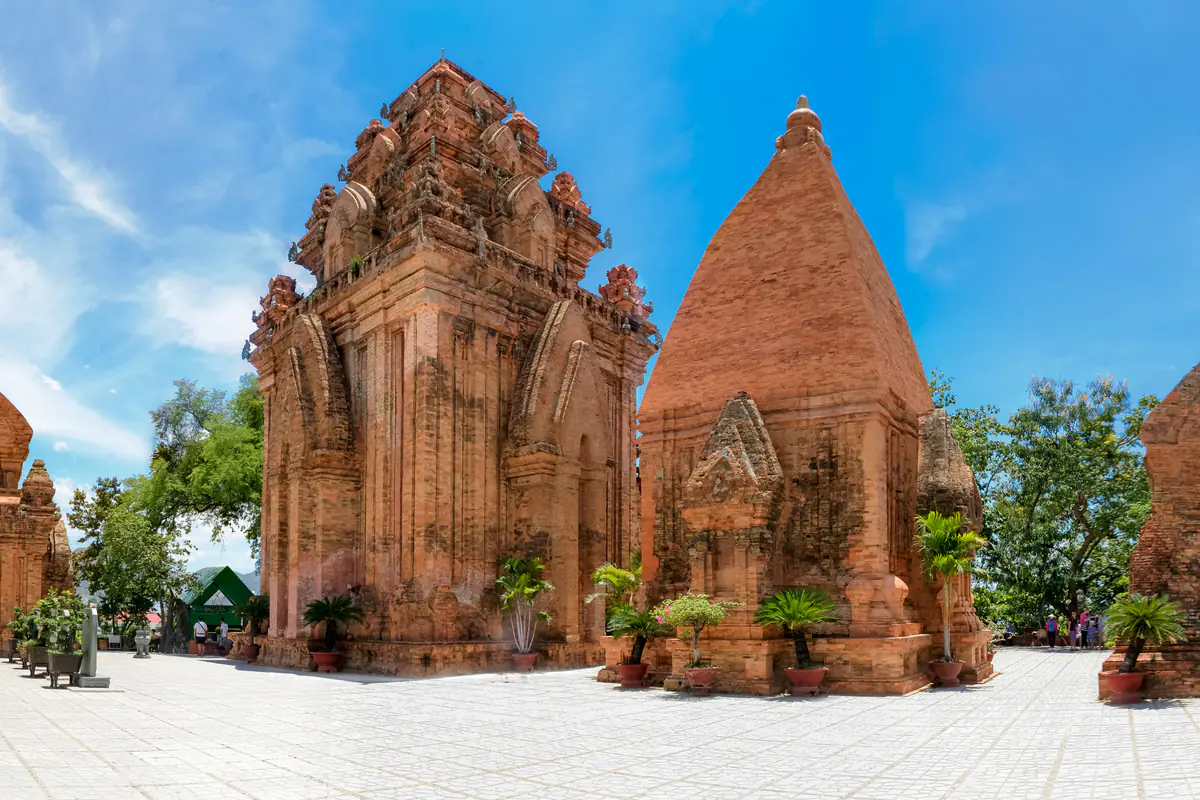
Photo: Makarenko Sasha · CC BY-SA 3.0 · Wikimedia Commons
Head north from Tran Phu Beach, cross Xom Bong Bridge, and a small hill rises right on the riverbank. A cluster of brick towers pokes out of the trees, facing the mouth of the Cai River, where the fishing fleet ties up in long rows.
Locals simply call it Thap Ba, the Lady's Tower. People still climb up to burn incense here every day, and every third lunar month the whole hill fills with pilgrims. It helps to arrive thinking of it as a working temple first and a historic site second, and to dress and behave the way you would in any place of worship.
Where the Po Nagar Cham Towers are and when to go #
The towers stand on Cu Lao Hill at 61 2 Thang 4 Street, in Bac Nha Trang Ward, right at the north end of Xom Bong Bridge. From the beachfront hotels, a taxi, ride-hailing car or motorbike gets you there in a few minutes once you are over the bridge. If you are staying on the north side of town, you can walk.
The terrace between the towers is paved brick with almost no shade, and the steps up the hill are fully exposed. On a sunny day, roughly 10 a.m. to 3 p.m., the bricks throw back heat and glare, and standing still to study a carving becomes a chore. Early morning or late afternoon is far more comfortable, and the low sun warms the color of the brick in photos.
Mid-morning is when tour buses tend to arrive. The terrace gets crowded and there can be a line to enter the main tower. If your schedule allows, go right at opening, or save it for the afternoon and follow it with a mud bath.
In the rainy season the stone steps and brick paving turn slick after a shower, so wear shoes with some grip. If you are traveling between October and December, check Nha Trang weather in October or the month-by-month guide to the best time to visit Nha Trang. The visit is short enough to slot into a dry spell between showers.
Who Po Nagar is: a short background #
The Cham built a kingdom, Champa, along this coast long before it became part of Vietnam. Their temples were brick towers, many of them dedicated to Hindu gods. Po Nagar is a group of these towers, built in stages between the 8th and 13th centuries, and it is still a place of worship today.
The goddess honored here is Po Inu Nagar, whom the Cham call the Mother of the Country. When Vietnamese settlers arrived around the 17th century, they adopted her as their own and named her Thien Y A Na, the Holy Mother. That is why, inside a Cham tower, you will find Vietnamese-style altars, incense bowls and hanging couplets.
In January 2025 the Po Nagar Cham Towers were listed as a Special National Monument, Vietnam's highest heritage ranking. You do not need to know any of this history to enjoy the visit, but it explains why worshippers and tourists share the same small terrace.
Stop 1: Xom Bong Bridge and the Cai River #
Xom Bong Bridge links downtown with the north side of the city, crossing the Cai River just before it meets the sea. If you are on foot or on a motorbike, slow down on the bridge. Below, blue and red fishing boats sit hull to hull, and on the seaward side the river opens into the bay.
The scene changes with the hour. Early in the morning the water is flat and the boats rest after a night at sea. Late in the afternoon the low sun from the mountains catches the water, and the towers on the hill turn a deeper shade of fired brick.
The bridge carries heavy traffic at rush hour. If you want a photo, step onto the pedestrian walkway rather than pulling over in a traffic lane. If you ride a motorbike to the towers, ask the parking fee before you hand over the key.
Arriving on the overnight train at Nha Trang Station early in the morning, with hours to go before check-in? Leave your bags at the hotel and spend that time at the towers, while the sun is still gentle and the terrace is quiet. The overnight train is one of the options covered in how to get to Nha Trang.
Stop 2: the steps and the pillared hall #
The site climbs the hillside in three levels: the gate at the bottom, a pillared hall in the middle and the towers at the top. Walking up, you reach the pillars before the towers come fully into view.
Scholars call the hall a mandapa, a space where worshippers paused before approaching the shrine. Its roof disappeared long ago. What remains are two rows of octagonal brick pillars on a raised platform. Stand between them and look up, and the tip of the main tower shows through the trees like a doorway framed in brick.
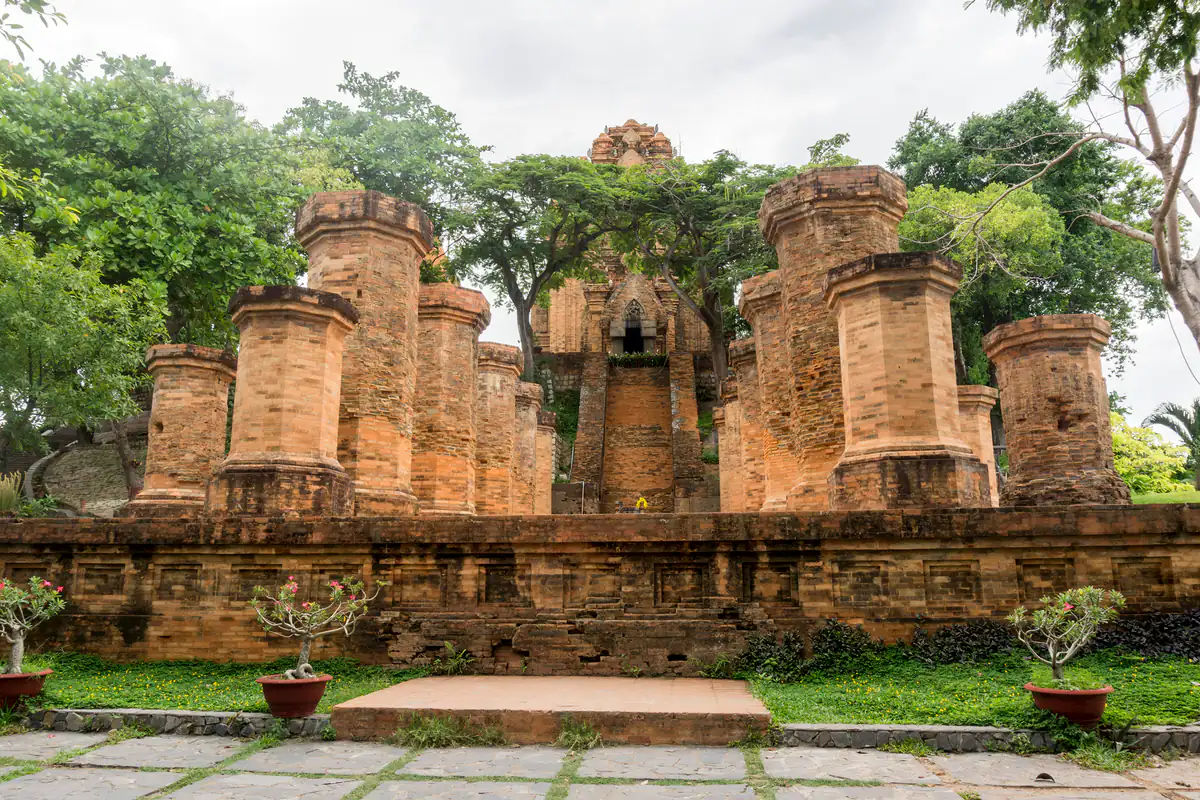
Photo: Castelfranco · CC BY-SA 4.0 · Wikimedia Commons
The steps to the tower terrace are steep and narrow, with no shade. Most people are up in a few minutes, but for older travelers or anyone with bad knees it is worth planning for. Take it slowly, rest at the pillared hall, and ask the staff at the gate whether there is an easier route that day.
A stroller will not make it up, so bring a baby carrier. Buy water at the bottom of the hill; once you reach the terrace you will probably want to stay longer than you expected.
Stop 3: the tower terrace and what to look for #
At the top, the brick terrace opens onto four standing towers, plus the foundations of two more. They were built in different periods, which is why each has its own shape.
The main tower is the largest, about 23 meters high, and houses the goddess. Stand close to its base and look up: the body steps inward level by level, and each corner carries a small brick ornament shaped like a miniature tower. The doorway faces east, so the front is best lit in the morning.
Before you step inside, look above the main doorway. A stone relief shows a many-armed goddess standing on a buffalo. Scholars identify her as Durga, the Hindu warrior goddess, a sign that the Cham blended their own mother goddess with deities from India.
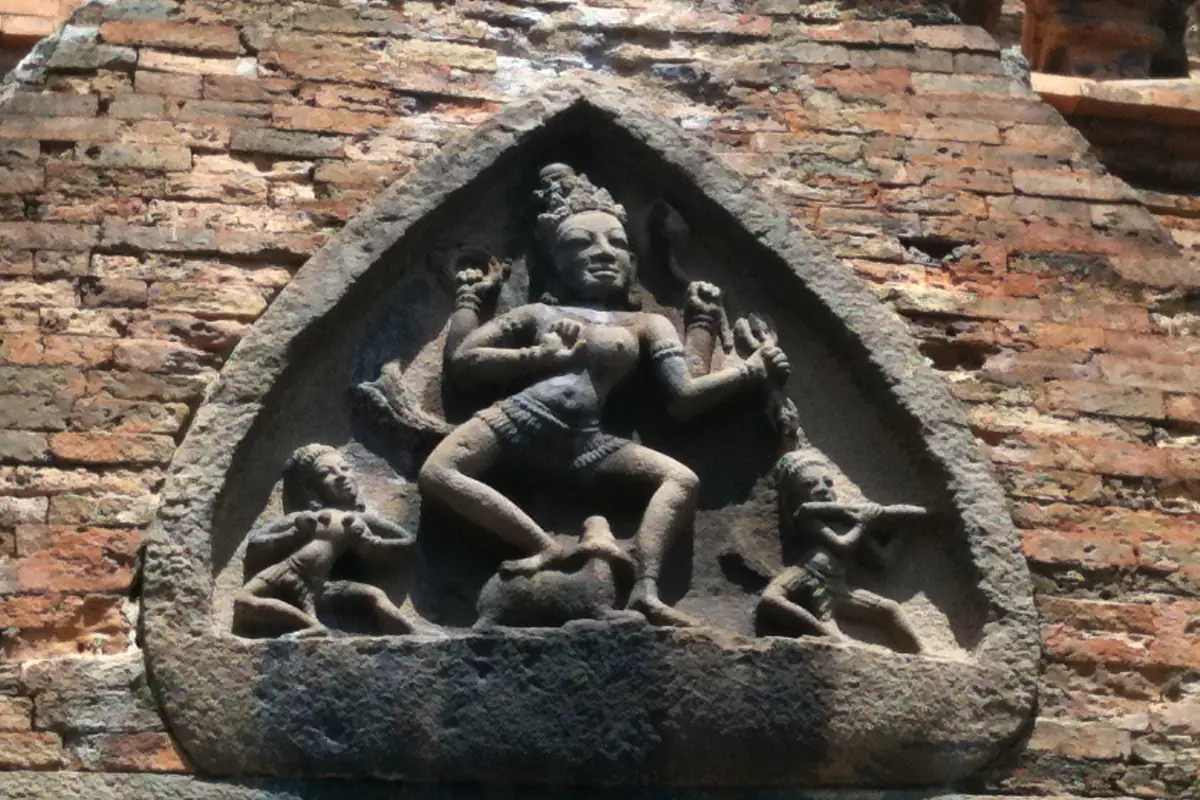
Photo: Dragfyre · CC BY-SA 3.0 · Wikimedia Commons
Inside, the stone statue of the goddess sits cross-legged with ten arms, each holding a different object. She is dressed in robes in the Vietnamese manner, and every festival season includes a ceremony to change her clothes. The chamber is dark, thick with incense and packed with people praying, so a few minutes is enough before you make room for the next person.
The South Tower, with its boat-shaped roof, is dedicated to Shiva. The smaller Northwest Tower honors Ganesha, the elephant-headed god. As you walk around, look closely at the walls: darker original brick sits next to lighter brick from later restoration work, and the seams are easy to spot.
Stop 4: dress code and etiquette inside the towers #
Sort out your clothes before you leave the hotel: shoulders covered, and shorts or skirts that reach below the knee. The site keeps cover-ups for visitors to borrow, and staff will politely point people in shorts or tank tops toward them. Arriving already dressed for it saves you from waiting in the sun for a loaner.
The easiest trick is a light scarf and a pair of packable long pants in your day bag. When you head on to the mud baths or the beach, you can take them off without a trip back to the hotel.
You do not have to light incense. If you want to, follow what the locals next to you do: a short prayer, the incense into the bowl, then step back for the next person. Donations go in the donation box, not on the statue or in its hands.
The best photos are usually outside rather than inside. To fit the whole group of towers in one frame, step back to the edge of the terrace in front of the main tower. In the morning the tower fronts catch the sun; by afternoon they fall into shade, and an angled shot works better.
Stop 5: the view over the Cai River #
The edge of the hill facing the river is where most people linger. Below, the Cai River runs out into the bay, Xom Bong Bridge stretches across the water and the fishing boats cluster along the banks. Beyond them rise the high-rises of downtown, and on a clear day the mountains behind the city.
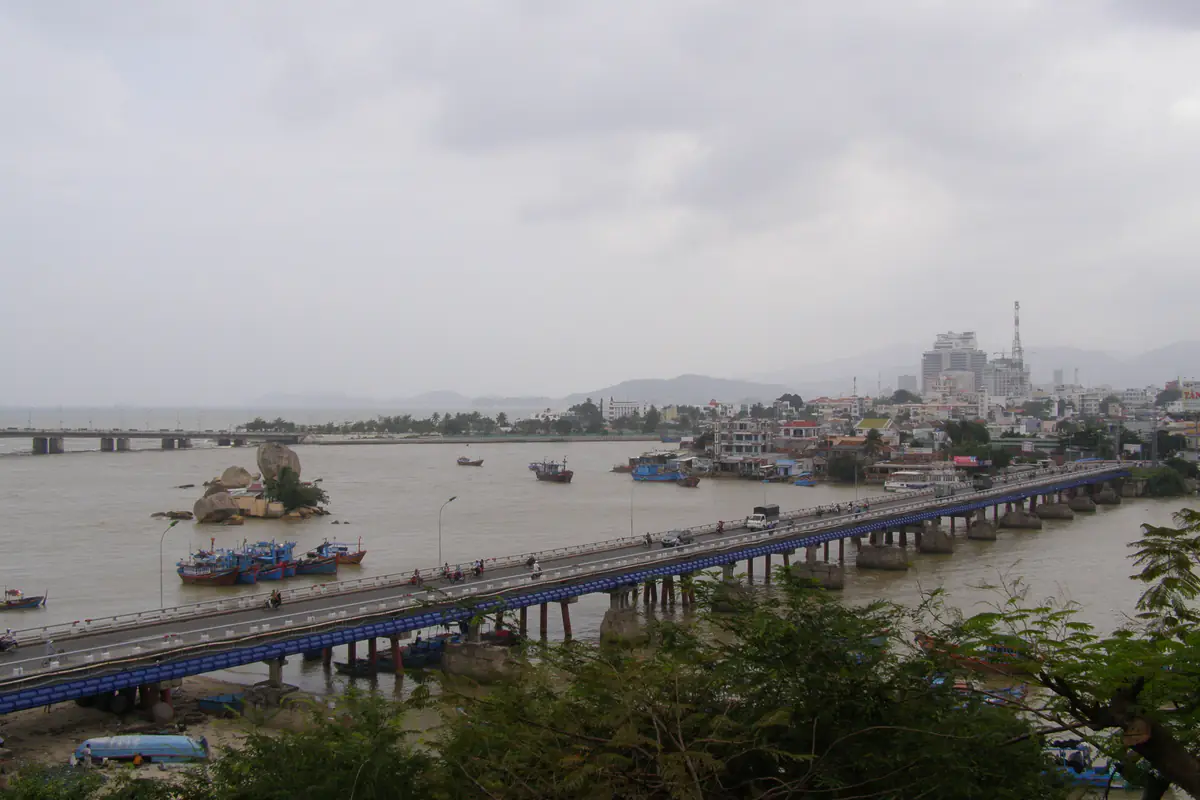
Photo: RG72 · CC BY-SA 4.0 · Wikimedia Commons
It is a good place to sit down after walking the terrace. The breeze coming off the river is noticeably cooler than the brick paving. With young kids, this is the moment for them to watch the boats and count bridges while the adults read up on the towers.
Keep small children away from the low walls along the hillside. If you plan to stay into the late afternoon, keep an eye on closing time so you are not hurrying down the steps in the dark.
Stop 6: where to go next #
The easiest thing to pair with the Po Nagar Cham Towers is a mud bath. The Thap Ba mud bath center is at 438 Ngo Den Street, a short ride from the towers. Do the towers in the morning and soak before lunch, or visit in the afternoon and stay in the mud until evening. Other mud bath options and Hon Chong are grouped in the north-side section of things to do in Nha Trang.
Hon Chong sits toward the sea and costs 30,000 VND per visit. Its stacked boulders at the water's edge look best in low, slanting light, so if you visit the towers in the morning, keep Hon Chong for the afternoon.
For lunch, look around Thap Ba Street, where local families eat. A bowl of fish noodle soup, a plate of banh can or a serving of chicken rice will do; the list of what to eat in Nha Trang helps you order before you sit down.
In the evening, head back downtown for the Nha Trang night market and a walk along Tran Phu Beach. If you prefer quiet and want the towers and mud baths without crossing the bridge back and forth, consider the north side near Hon Chong when choosing where to stay in Nha Trang.
The Po Nagar festival and Cham dance #
The Po Nagar festival takes place in the third lunar month, with the traditional main days on the 20th to 23rd. It was listed as national intangible cultural heritage in 2012. In 2026 it ran from May 5 to 11, the 19th to 25th days of the third lunar month.
The ritual most people wait for is the bathing of the goddess statue and the changing of her robes, usually around midday on the main day. That evening a palanquin procession winds through the streets near the towers, followed by prayers and a release of floating lanterns on the Cai River. The detailed 2026 schedule from Khanh Hoa Newspaper (in Vietnamese) gives a good idea of how the days unfold in later years.
During the festival the hill draws thousands of people and more than a hundred pilgrim groups, many of them Cham communities traveling up from the south. Drums and Cham dancing among the old towers are things you rarely see on an ordinary day.
The trade-off is the crowd. Arrive early, park a little farther away and walk, wear your bag in front, dress more conservatively than usual and be patient in the line for the main tower. If you want to study the architecture in peace, skip festival week. Because the dates follow the lunar calendar, the festival usually falls in April or May.
On ordinary days, Cham dancers have at times performed on the terrace, mostly on weekends and holidays. The schedule changes from season to season, so ask at the ticket desk when you arrive. The evening shows held on the 1st and 15th of each lunar month in 2025 were proposed for suspension in early 2026, so do not plan your trip around them.
Pros and cons to know before you go #
👍 What we like
- A working Cham temple, not just a ruin to photograph
- 30,000 VND ticket, and an hour covers it
- Views over the mouth of the Cai River and Xom Bong Bridge
- Close to the Thap Ba mud baths and Hon Chong, easy to combine
👀 Keep in mind
- Little shade on the terrace, and the midday sun is harsh
- Steep, narrow steps, hard for older travelers and strollers
- Crowded mid-morning and during the festival, with a wait for the main tower
- The inside of the towers is dark and smoky, not a place to linger
If you only have half a day in Nha Trang and historic sites are not your thing, a morning on the beach may suit you better. If you are curious about the Cham layer beneath this beach city, though, Po Nagar is the closest and easiest place to see it.
Families with young children do well to pair the towers with a mud bath, so the outing is not all standing and listening. Older travelers should go early, bring water and allow time to rest at the pillared hall before the final climb.
Frequently asked questions about the Po Nagar Cham Towers #
What is the dress code at the Po Nagar Cham Towers?
Cover your shoulders and wear shorts or skirts that reach below the knee. The site lends cover-ups to visitors in shorts or tank tops, but bringing a light scarf and packable long pants is easier, especially if you are heading to the beach or a mud bath afterward.
How much is the entrance fee, and what are the opening hours?
Tickets cost 30,000 VND per person per visit (rate in force since January 2023, checked September 2026); local residents, seniors and people with disabilities enter free. The site is open during the day, but published opening and closing times do not agree, so call +84 899 789 815 before you go.
Who is worshipped at Po Nagar?
The goddess Po Inu Nagar, the Mother of the Country for the Cham people. Vietnamese worshippers honor her as Thien Y A Na, the Holy Mother. Her ten-armed stone statue sits inside the main tower.
When is the Po Nagar festival?
In the third lunar month, with the traditional main days on the 20th to 23rd, usually falling in April or May. In 2026 it ran from May 5 to 11, with the bathing and robing of the statue, a palanquin procession and floating lanterns on the Cai River.
Can I combine the towers with a mud bath?
Yes. The Thap Ba mud bath center at 438 Ngo Den Street is a short ride away, so many visitors do the towers in the morning and a mud bath afterward, or the other way around. Hon Chong is also nearby, with a 30,000 VND ticket.
📚 Sources
Information in this article draws on the sources below, as of the update date.
- Vietnam Government News (Báo Chính phủ): Po Nagar receives Special National Monument certificate (July 11, 2025)
- Khanh Hoa Newspaper: Key dates and activities of the 2026 Po Nagar Festival (May 2026)
- VnExpress International: Vietnam temple Po Nagar, pinnacle of Champa splendor (November 24, 2020)
- Viet Nam News: Khanh Hoa's 1,000-year-old Cham towers become tourist hotspots (July 15, 2025)
- Tuoi Tre: Po Nagar festival at night (May 6, 2026, in Vietnamese)
- Department of Cultural Heritage: The Po Nagar Festival (in Vietnamese)
- VnExpress: Po Nagar and Hon Chong entrance fees rise 50% (November 30, 2022, in Vietnamese)
- Tuoi Tre: Visitors in revealing clothes can borrow ao dai at Po Nagar (in Vietnamese)
- Dan Tri: Why the Po Nagar evening art program was proposed for suspension (February 3, 2026, in Vietnamese)
- Khanh Hoa Smart Tourism Center: Po Nagar (checked September 30, 2026)
- Wikipedia: Po Nagar
Related posts
Places
VinWonders Nha Trang: A Full Day on Hon Tre Island, From Tickets to the Tata Show
Morning in a glass cable car over the bay, midday on the water slides, evening in the crowd waiting for the Tata Show to light up the square. Planning a day at VinWonders Nha Trang? Here is how to time it, pick a ticket and plan a day that works for the whole family.
Places
Nha Trang Night Market and Nha Trang After Dark: One Evening From Beach to Street
The sun slips behind the mountains, the lights along Tran Phu Street flicker on and the breeze off the bay smells of grilled squid. An evening here can run from the sand to dinner, through the Nha Trang night market and back to your hotel on foot.
Places
Things to Do in Nha Trang: 12 Best Sights From City to Islands
From Tran Phu beach, cross the Cai River to the Po Nagar towers and the Hon Chong rocks, then head south to where the bay opens onto its islands. These 12 things to do in Nha Trang run in four connected clusters, with ticket prices and tips.