Nha Trang Oceanographic Museum (Bảo tàng Hải dương học): Tanks, Tickets and Timing
The Museum of Oceanography at Cau Da (Cầu Đá) fits into one unhurried morning and keeps you mostly under a roof: fish tanks, a whale skeleton and a gallery cut into a hillside tunnel. It is an easy choice for families with young children and for days when the sea is too rough for a boat trip.
Written by Tụi mình mê biểnPublished Updated
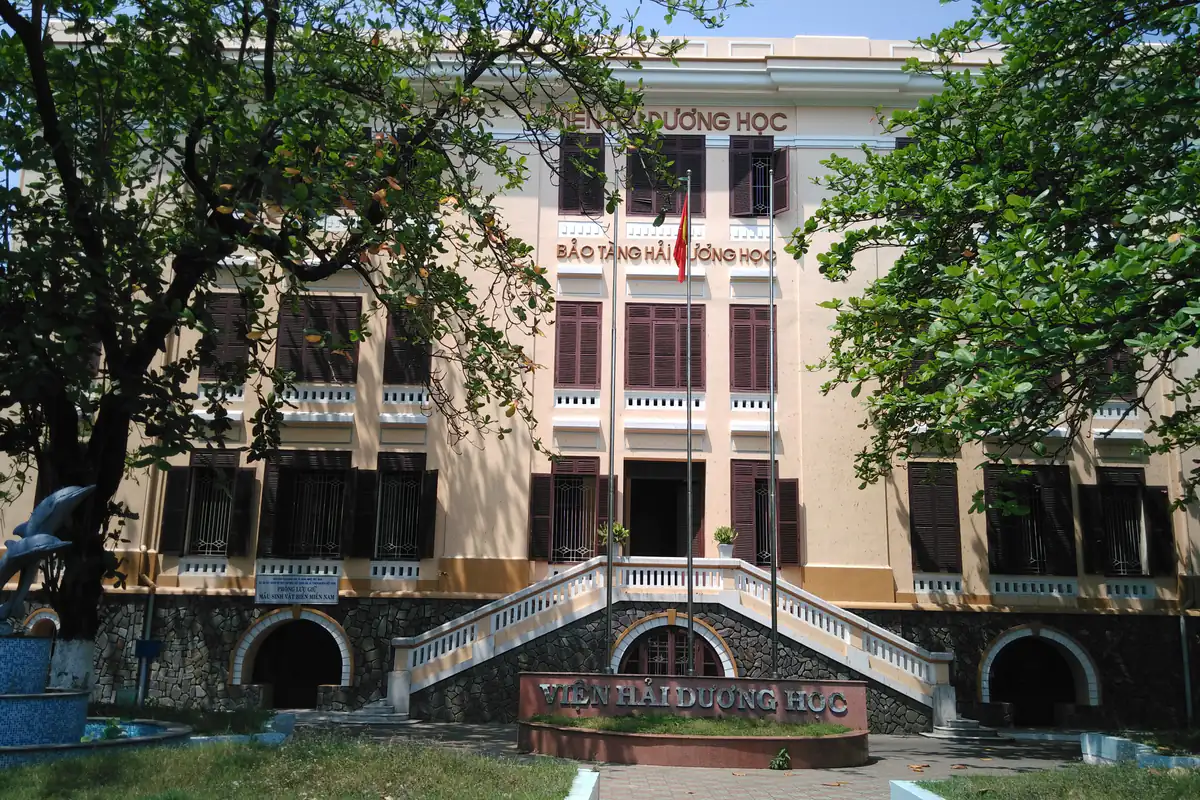
Photo: Phương Huy
Follow Tran Phu (Trần Phú) Street south until the beach runs out and you reach the port at Cau Da. Right beside it stands a pale yellow colonial building with a double staircase, brown shutters and the institute's name across the front. Behind it, other buildings sit among trees: this is where sea turtles swim in tanks, a whale skeleton fills a hall and jars of preserved specimens line the walls.
This is not a commercial aquarium but the museum of a working marine research institute whose predecessor was founded in 1922. The main draws are the live tanks and specimen collections, with plenty of scientific displays to read along the way.
What to see: the five zones #
Tickets are sold at a counter by the gate on Tran Phu Street; bring a student or school ID if you are buying a discounted ticket, in case the counter asks. The exhibits fill five zones in separate buildings. The visitor map on the museum's website, uploaded in 2019 and labeled in Vietnamese, English, French and Russian, starts with the live tanks and ends with the specimen rooms; check the signs on arrival for the current route.
| Zone | What is there | Our take |
|---|---|---|
| 1. Live tanks | Reef fish, sea turtles, sharks, rays, eels, lobsters and living coral | Where young children usually want to stay longest |
| 2. Large specimens | An 18 m humpback whale skeleton, a dugong skeleton, a near one-tonne manta ray | The family photo stop |
| 3. Artificial reef | Models of structures sunk on the seabed to shelter fish and anchor coral | Quick walk-through |
| 4. Hoang Sa (Hoàng Sa) - Truong Sa (Trường Sa) gallery | A hillside tunnel: specimens and rocks from the Paracel and Spratly islands, tanks, a dome tank | Save time for the dome tank |
| 5. Marine biodiversity | Shelves of preserved specimens, a 145 kg giant clam, a sharptail sunfish, a spotted seal | Best for adults who like biology |
The tanks: turtles, sharks and a fish to admire from a distance
The live tanks are the liveliest part of the visit. Besides the turtles and sharks, look for the lionfish, all fanned-out fins and stripes; the museum's own notes point out that its dorsal spines carry venom. It makes an easy lesson for children about not touching unfamiliar creatures in the sea. Divers, mostly technicians from the institute, sometimes go into the tanks to work or put on a show. We found no fixed schedule on the museum's website, so ask at the ticket counter.
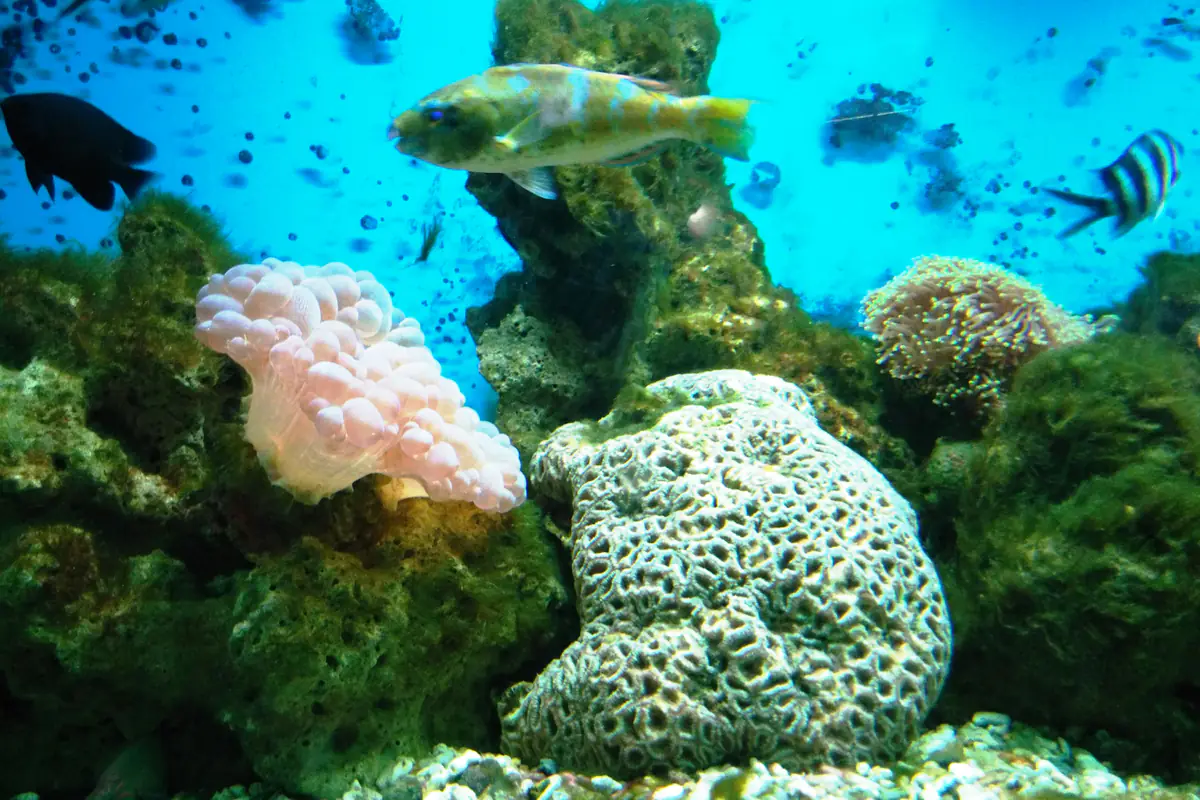
Photo: Phương Huy
The 18-meter humpback whale skeleton
The skeleton weighs about 10 tonnes. Villagers in Hai Cuong (Hải Cường) commune, in what was then Nam Dinh (Nam Định) Province in northern Vietnam, dug it up in 1994 while cutting an irrigation ditch about 4 km from the sea, and the museum says it had lain underground for more than 200 years. Stand at the head end and look down its length to take in the size.
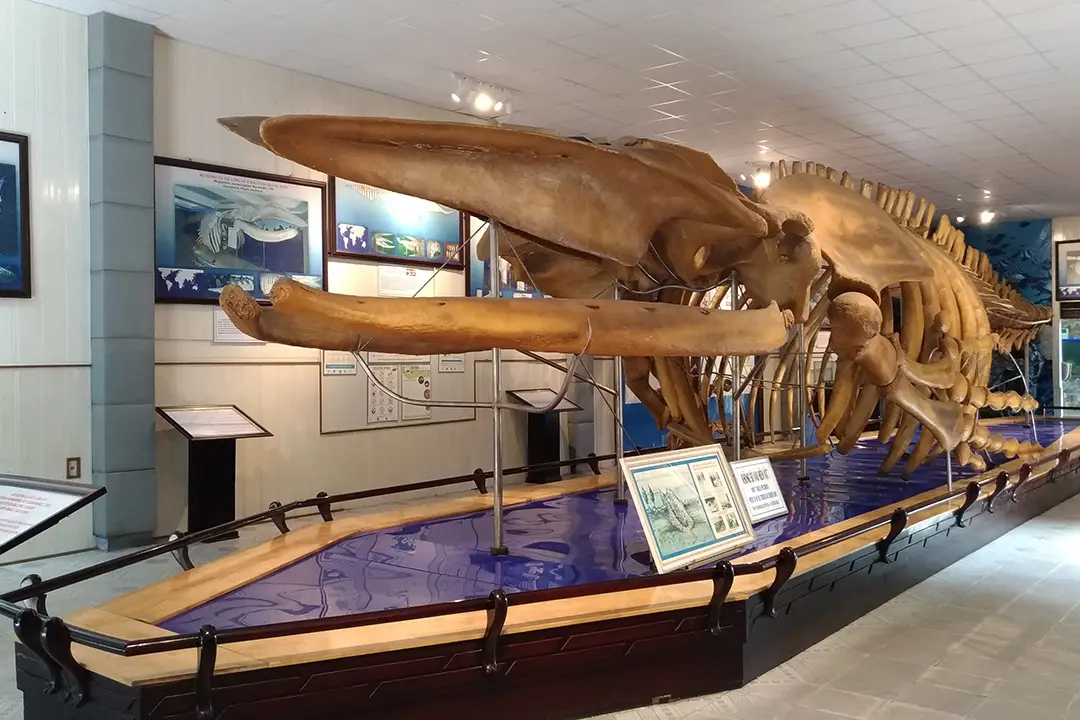
Photo: Bảo tàng Hải dương học
The tunnel gallery and the specimen rooms
The Hoang Sa - Truong Sa gallery, covering the Paracel and Spratly archipelagos, runs through a tunnel the French cut into the hill in 1930. At the far end is a 25-meter dome tank, which held a group of sharks in 2022.
The fifth zone on the map is the biodiversity collection, where tall shelves are crowded with preserved specimens. If you like biology, leave time for this one.
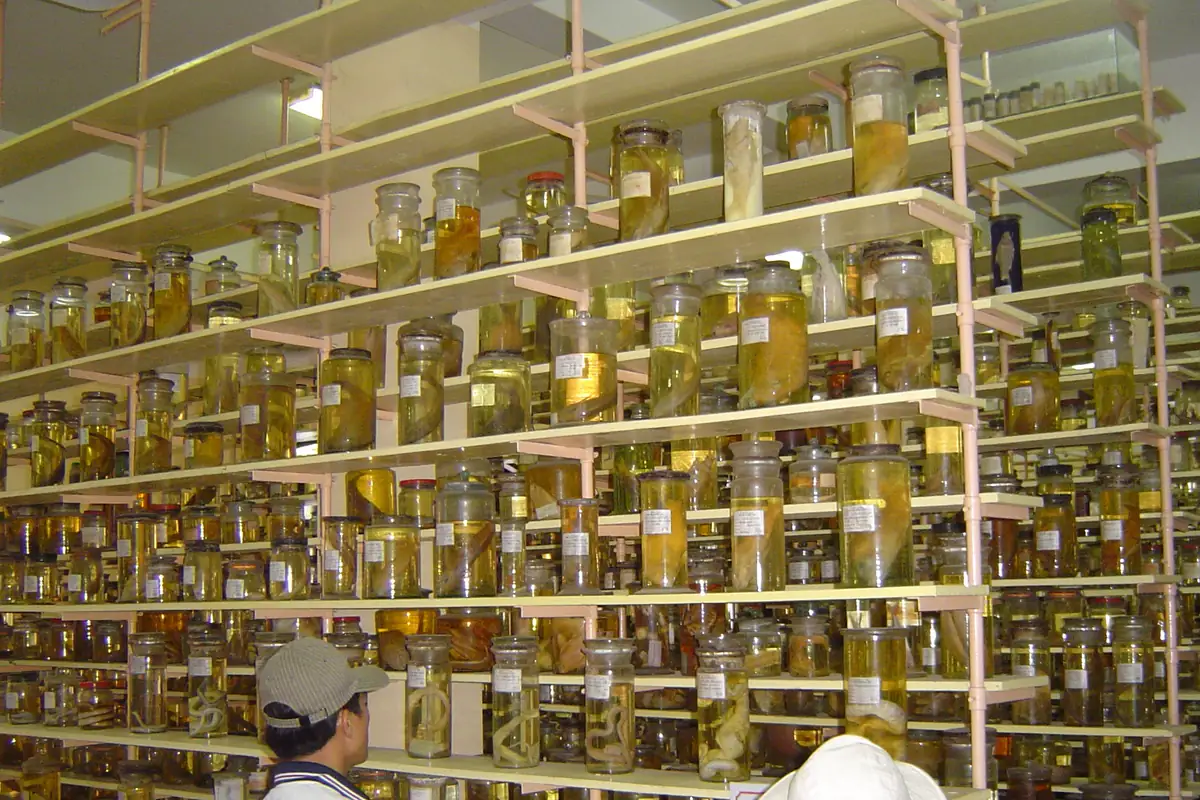
Photo: Lưu Ly
How long to allow, and when it is quieter #
A full loop of the five zones, reading the panels at a normal pace, takes about 1-1.5 hours. If you only want the tanks and the whale, 45 minutes is enough.
Doors open at 6 a.m., and early on a weekday is the calmest time. Public holidays are a different story. Over four days of the 2025 holiday marking April 30 and May 1, the museum received more than 27,000 visits and people shuffled past the big tanks a step at a time. On a holiday, be there at opening. For a guided visit, especially with a group or a class, call ahead and ask for the museum's communications team.
Who it suits, and the drawbacks #
With young children, spend most of the visit at the live tanks; the preserved specimen rooms usually suit older children better. An adult should stay close and watch them at all times, especially on stairs and around the tanks and pools.
If you are used to big modern aquariums or want shows at set times, it may underwhelm. Some halls are dated, and this is a place for looking and reading more than for hands-on fun. The aquarium at VinWonders is more modern but comes inside a full-day ticket on the island; the two do not replace each other. Couples and groups of friends will probably want an hour here and the rest of the morning on the beach.
Getting there: the end of Tran Phu, beside Cau Da port #
A car or motorbike through a ride-hailing app is the simplest option; with small children, take a car. Enter "Viện Hải dương học" or "1 Cầu Đá" as the destination. On your first day, the open-top sightseeing bus also loops past the institute.
The neighboring Cau Da port is no longer the main departure point for island tours: since May 16, 2020, tour boats have used the pier on Vo Thi Sau (Võ Thị Sáu) Street. If you want to see the museum after a day on the boats, check where the boat drops you and when it gets back.
Do not confuse the main site with the "Mysteries of the Ocean" deep-sea exhibit that opened on September 2, 2025. It is at the museum's Hon Chong (Hòn Chồng) hill site in Bac Nha Trang (Bắc Nha Trang) ward, about 8 km north of Cau Da. In the sources we checked up to October 20, 2026, we found no current hours or ticket prices for that site, so call the museum before heading there.
Which day of your trip it suits #
- Afternoon flight home: spend the last morning of a three-day trip at the museum.
- A long rainy spell with no warnings in force: the museum in the morning, lunch near your hotel and, if the rain is light, a mud bath in the afternoon. The walks between buildings are outdoors, so bring an umbrella or a light rain jacket.
- Traveling with young children: make it the main outing of one day in a slow four-day itinerary.
Keep VinWonders for a different day. If heavy rain or flood warnings are issued for Khanh Hoa (Khánh Hòa), postpone any trip that is not essential, the museum included, and follow official guidance. With a free afternoon, add one more sight in town; we group them into four easy clusters.
Museum of Oceanography FAQ #
Are the Institute of Oceanography and the Museum of Oceanography the same place?
The museum belongs to the Institute of Oceanography, part of the Vietnam Academy of Science and Technology. The ticketed part is the museum at 1 Cau Da; the other buildings on the grounds are the institute's offices and research facilities.
Is the museum open over Lunar New Year (Tet)?
The museum's website says it opens 6 a.m.-6 p.m. every day of the week. According to Kenh14 (October 2024), the museum's Facebook page once stated that it closes on the last day of the lunar year and the first day of Tet. If you plan to visit then, call +84 258 3590 036 first.
Can I buy tickets online?
As of October 20, 2026, we found no online ticket sales on the museum's website. Tickets are sold at the counter by the gate on Tran Phu Street.
📚 Sources
Information in this article draws on the sources below, as of the update date.
- Museum of Oceanography: Visit page, hours, admission and parking fees, visitor map uploaded October 2019 (page updated October 13, 2026, viewed October 20, 2026, in Vietnamese)
- Museum of Oceanography: Exhibition zones, live tanks, large specimens, Hoang Sa - Truong Sa gallery, marine biodiversity (page updated June 17, 2021, viewed October 20, 2026, in Vietnamese)
- Museum of Oceanography: "Mysteries of the Ocean" exhibit opens at Hon Chong hill (September 2, 2025, in Vietnamese)
- Tuoi Tre News: Nha Trang ocean museum exhibit takes visitors on journey 6,000 meters beneath sea (September 5, 2025)
- Sai Gon Giai Phong: The Hon Chong site is about 8 km north of the institute (September 3, 2025, in Vietnamese)
- Thanh Nien: Crowds at the Museum of Oceanography over the April 30 - May 1 holiday (May 3, 2025, in Vietnamese)
- Dan Tri: The 18-meter, 10-tonne humpback whale skeleton in Nha Trang (August 25, 2017, in Vietnamese)
- VnExpress: The aquarium in a tunnel through the hill, dug in 1930, with a 25-meter dome tank (May 10, 2022, archived copy, in Vietnamese)
- Kenh14: The museum's opening hours, closed on the last day of the lunar year and the first day of Tet, per its Facebook page (October 5, 2024, in Vietnamese)
- VnExpress International: The Institute of Oceanography, next to Cau Da port, about 6 km from the center (April 14, 2021)
- VinWonders Wonderpedia: Nha Trang tourist pier on Vo Thi Sau Street, in use since May 16, 2020 (October 24, 2025, in Vietnamese)
Related posts
Places
Nha Trang Cathedral (Nhà thờ Núi): Hours, Mass Times, Dress Code and Etiquette
Opening hours, Mass times, entrance fee, dress code and etiquette at Nha Trang's hilltop cathedral, plus how to pair it with the train station, Long Son Pagoda and Dam Market.
Places
Day Trips from Nha Trang: Where to Go and When
Six trips out of the city to the north, west and south, with tickets, opening hours and which ones to save for the dry season.
Places
Nha Trang Mud Bath Guide: Where to Go, What to Wear and What to Bring
Five mud baths compared by price, hours and who they suit, plus what to wear and pack.