Nha Trang Money Exchange, ATMs and Payments: What to Know First
Where you can legally change money, how to get dong from an ATM without overpaying, and when only cash will do: a practical guide for your first days in Nha Trang, with notes for Russian, Korean and other visitors.
Written by Tụi mình mê biểnPublished Updated
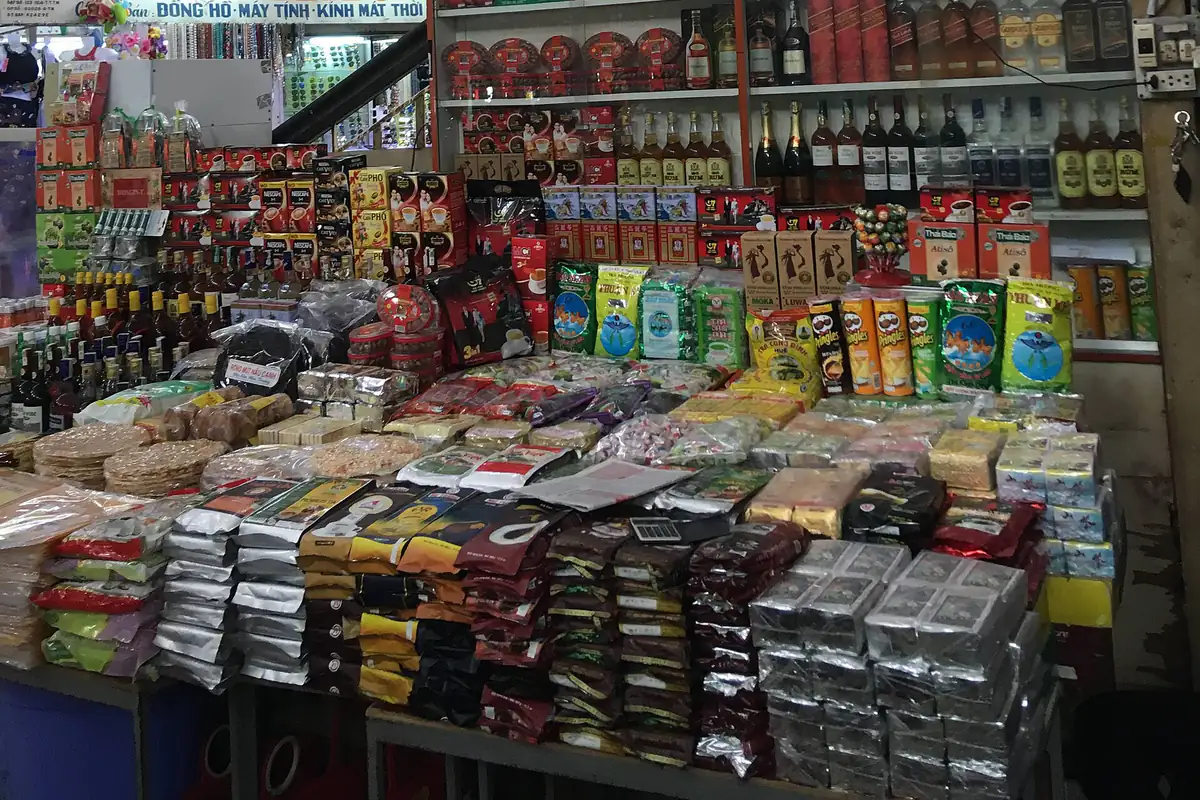
Photo: Christophe95
Vietnam's currency is the dong, written VND or ₫. Prices run into the thousands and hundreds of thousands, and the zeros take a day or two to get used to.
In Nha Trang you will switch between three ways to pay. Cash covers street food, markets and many motorbike taxis. Cards work at hotels, supermarkets and larger restaurants. QR codes are on many counters, but they are built for Vietnamese banking apps; only visitors from a few countries can scan them with an app from home.
Where you can legally change money #
Vietnam is strict about who may buy and sell foreign currency. The State Bank of Vietnam advises people to buy or sell foreign cash only at licensed banks, and to sell foreign currency for dong only at exchange agents that hold its registration certificate. Swapping money with another person, or at a shop without a license, breaks the rules even when the rate looks better.
In Khanh Hoa (Khánh Hòa) Province, the State Bank's regional branch says licensed agents can be based in hotels rated three stars and up, tourist sites, entertainment areas, the airport and shopping malls. On a package tour, ask your tour company: some hold an agent license and change money for their guests. Only use a gold shop if that location is a licensed exchange agent. In early October, several jewelers in Nha Trang asked by Tuoi Tre declined to change money because they were not licensed.
At any counter outside a bank, ask whether it is a licensed exchange agent and which bank it works for, and check the posted rate. Count your dong before you leave the counter and ask for a receipt.
What happens if you use an unlicensed exchanger
Penalties are set by Decree 340/2025/ND-CP, in force since February 9, 2026. For individuals who buy or sell foreign currency with another person, or at a place not licensed to exchange it, Article 27 scales the penalty to the amount:
| Amount exchanged | Penalty (individual) | Also |
|---|---|---|
| Under US$1,000, first time | Warning | No confiscation |
| Under US$1,000, repeat or multiple offenses | VND10-20 million | The foreign currency or dong is confiscated |
| US$1,000 to under US$10,000 | VND10-20 million | The foreign currency or dong is confiscated |
| US$10,000 to under US$100,000 | VND20-30 million | The foreign currency or dong is confiscated |
| US$100,000 or more | VND80-100 million | The foreign currency or dong is confiscated |
Organizations pay double the individual fines. The same scale applies to paying for goods or services in foreign currency where the law does not allow it, so pay in dong, even if a shop quotes you a price in dollars. Conduct classified as unlicensed foreign-exchange operations under Article 27(8)(c) carries fines of VND200-250 million for individuals and VND400-500 million for organizations.
Using an unlicensed exchanger also leaves you with less recourse if you receive the wrong amount or suspect a counterfeit note.
Banks, hotels or the airport? #
A bank is the safest choice, especially for larger amounts. Take your passport and check the branch's opening hours before you go, particularly on weekends. Each bank sets its own cash buying rate and adjusts it during the day, so we suggest comparing two or three banks' online rate boards first. Crisp notes without tears or pen marks are less likely to be refused.
The international terminal (T2) at Cam Ranh Airport lists ATMs open around the clock and a currency exchange counter that opens according to the flight schedule. We suggest changing or withdrawing just enough for the ride into town and a first meal, then changing the rest at a bank in the city, where rates are easier to compare. For buses and taxis, see our guide to getting from Cam Ranh into town. If your hotel has a licensed exchange desk, ask for the rate before you hand over any money.
Using ATMs with a foreign card #
With a Visa or Mastercard issued abroad, an ATM is usually the simplest way to get dong. A withdrawal can carry fees at both ends: from the bank that owns the machine and from your own card issuer. Each bank also sets its own limit per withdrawal, so taking out a large sum may mean several transactions, each with its own fee.
Read the screen before you confirm. If offered dynamic currency conversion (DCC), choose VND and decline the machine's conversion. Check the withdrawal fee separately before confirming. Accepting the conversion on the spot means taking the rate set by the machine's operator, which is usually less favorable than your card issuer's. The same applies at hotel and shop card terminals.
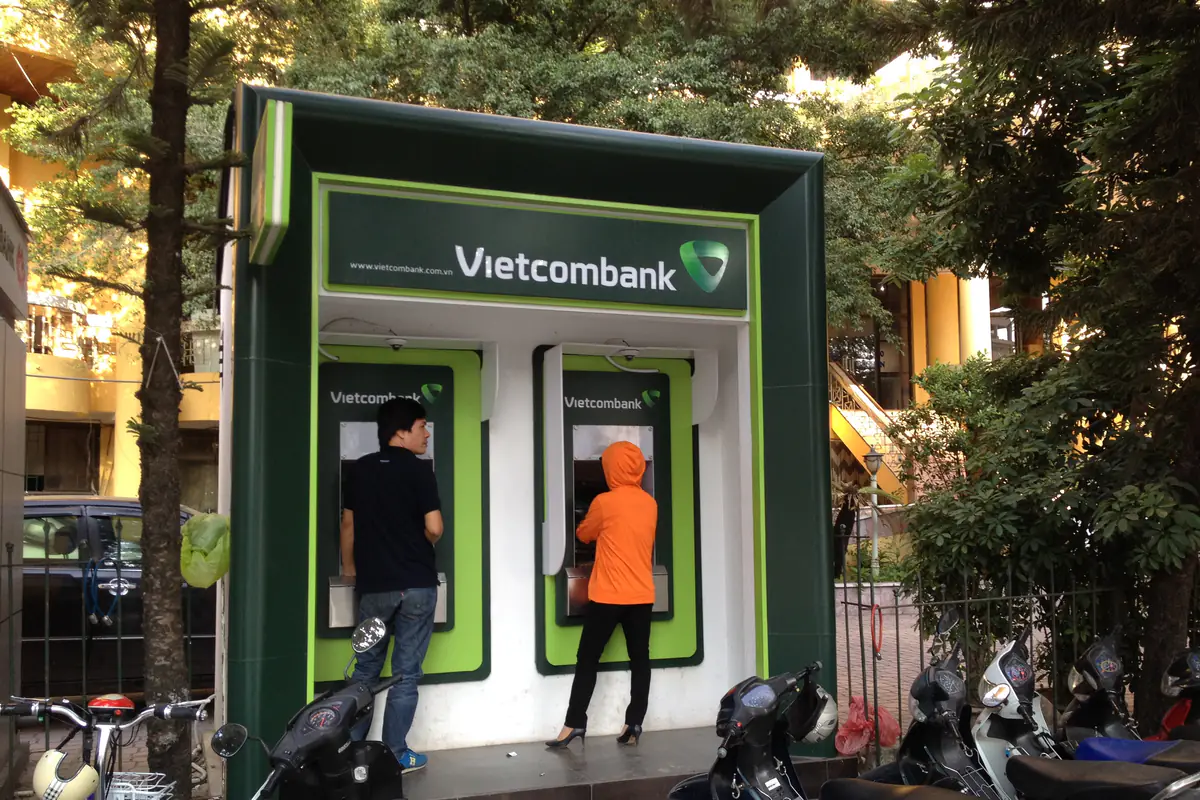
Photo: Phan Minh Tuấn
Credit cards work at ATMs too, but the withdrawal counts as a cash advance; check your issuer's fees and interest before you use one. Where you can, use an ATM inside or right next to a bank branch during business hours, so there is someone to help if the machine keeps your card. Count the notes at the machine and put them away before you step back onto the street.
Traveling from Russia: Mir cards and VRB ATMs
Since March 2022, when Visa suspended its operations in Russia, Visa cards issued there no longer work abroad. Russia's domestic Mir cards do work in some places in Vietnam. Under an agreement between NAPAS and NSPK, Russia's national card system, announced in 2019, Mir cardholders can withdraw cash at ATMs of the Vietnam-Russia Joint Venture Bank (VRB). Acceptance depends on the issuing bank and payment terminal, so check with your bank before traveling.
In late September, Tuoi Tre and VnExpress both reported Russian tourists queuing at VRB ATMs: outside the Muong Thanh Vien Trieu (Mường Thanh Viễn Triều) complex and on Pham Van Dong Street (Phạm Văn Đồng) in Bac Nha Trang Ward (phường Bắc Nha Trang), at the Le Thanh Phuong (Lê Thành Phương) and Thong Nhat (Thống Nhất) intersection, and at some machines on Tran Phu (Trần Phú). VnExpress reported a limit of VND10 million per withdrawal at VRB ATMs. VRB said the queues only build at certain hours and that it has proposed adding cash points; BIDV said some Russian visitors' cards also work at its ATMs.
Our suggestion: withdraw enough for several days each time you go, come back at another hour if the line is long, and keep some US dollars in cash to change at a bank in case the nearest machine is out of order.
From South Korea and other QR-linked countries
Since April 23, 2026, visitors from South Korea using mobile wallets and banking apps in the GLN International network, part of Hana Financial Group, can scan VietQRGlobal codes to pay in Vietnam. Won are converted straight into dong through Hana Bank and BIDV. Before your trip, check whether your bank or wallet is part of the network.
According to the State Bank of Vietnam, Vietnam also has two-way QR payment links with Thailand, Laos, Cambodia, China and Singapore; Chinese visitors can pay through UnionPay, Alipay and Weixin Pay. VietQRGlobal is still accepted at only about 154,000 of more than 2.5 million payment points nationwide, roughly 6%, so keep cash or a card as your main option.
The Travel Wallet prepaid card that many Korean travelers carry is a Visa card, and its issuer says it can withdraw local currency at ATMs on the Visa network.
Cash or card around Nha Trang #
Street stalls, Dam Market (chợ Đầm), sugarcane juice carts and roadside snack counters usually take cash or a bank transfer through a Vietnamese QR code. Without a local bank account, or one of the linked apps above, plan on cash. Carry small notes for the night market and for breakfast and street snacks.
Hotels, supermarkets, larger restaurants and attractions usually take cards. At the I-Resort mud bath, for example, the ticket counter accepts both cash and cards. In the Grab app you can link an international credit or debit card to pay for rides; keep some cash in case the card is declined.
Check the printed value before handing over a note, especially VND20,000 and VND500,000. According to the State Bank of Vietnam, the 20,000 note is deep blue with the Japanese Covered Bridge (Chùa Cầu) in Hoi An (Hội An) on the back, while the 500,000 is a darker violet-blue with Ho Chi Minh's family house in Kim Lien (Kim Liên).
Bringing cash into Vietnam #
Arriving travelers carrying more than US$5,000 (or the equivalent in another foreign currency) or more than VND15 million in cash must declare it at customs. Since July 1, 2026, penalties have been set by Decree 169/2026/ND-CP; they depend on the offense and the amount involved, and different rules apply when entering and leaving Vietnam. If you are carrying more than the thresholds above, declare it when you arrive.
Nha Trang money exchange FAQ #
Where can I exchange money in Nha Trang?
At a bank, or at an exchange agent licensed by the State Bank of Vietnam, which only buys foreign currency from you. On arrival, Cam Ranh Airport's international terminal T2 has an exchange counter.
Can I change dollars at a gold shop in Nha Trang?
Only if the shop is a licensed exchange agent. Check its authorization before handing over money; the penalties for using an unlicensed exchanger are listed above.
Can Russian tourists withdraw cash in Nha Trang?
Yes, with a Mir card at VRB ATMs, up to VND10 million per withdrawal. Whether the card works elsewhere depends on the issuing bank, so check before you travel.
Should I pay in dong or in my home currency at an ATM or card terminal?
Choose dong (VND). If you accept conversion on the spot, you take the rate set by the machine's operator, which is usually less favorable than your card issuer's.
Do I need cash in Nha Trang?
Yes, for street food, markets, small shops and many motorbike taxis. Hotels, supermarkets, larger restaurants and attractions usually take cards.
📚 Sources
Information in this article draws on the sources below, as of the update date.
- Government of Vietnam: Decree 340/2025/ND-CP on administrative penalties in currency and banking, Articles 5, 27 and 32 (December 25, 2025, in force February 9, 2026, in Vietnamese)
- Tuoi Tre: What residents and tourists should do when they need to change foreign currency (October 2, 2026, in Vietnamese)
- Vietnam Lawyers Magazine: State Bank of Vietnam advice on buying and selling foreign currency (July 5, 2026, in Vietnamese)
- Tuoi Tre: Why Russian tourists are queuing at ATMs in Nha Trang (September 30, 2026, in Vietnamese)
- VnExpress: Russian tourists queue at an ATM in Nha Trang (September 30, 2026, in Vietnamese)
- VRB: VRB cooperates with NAPAS and NSPK on payment services for Mir cards in Vietnam (November 4, 2019)
- Visa: Visa Suspends All Russia Operations (March 5, 2022)
- Cam Ranh International Airport: Facilities and services, ATMs and currency exchange in terminal T2 (checked October 10, 2026)
- Vietnam Banks Association: Vietnam-South Korea cross-border QR payments launched (April 23, 2026, in Vietnamese)
- Vietnam Banks Association: Cross-border QR payments, from connection to everyday use (September 28, 2026, in Vietnamese)
- Tuoi Tre News: Only 6% of Vietnam's payment points offer VietQR Global to international visitors (September 26, 2026)
- Travel Wallet: Card overview, withdrawals at Visa ATMs (checked October 10, 2026, in Korean)
- State Bank of Vietnam: Vietnamese currency, size and color of each banknote (checked October 10, 2026, in Vietnamese)
- I-Resort Nha Trang: Payment methods (checked October 8, 2026, in Vietnamese)
- Grab Vietnam: Paying in the Grab app, linking an international card (checked October 10, 2026)
- Government of Vietnam news portal: Penalties for travelers who fail to declare, or misdeclare, cash and gold above the limit, Decree 169/2026/ND-CP (May 20, 2026, in Vietnamese)
- Visa: What you should know about Dynamic Currency Conversion (checked October 10, 2026)
Related posts
Guides
Where to Stay in Nha Trang: Six Areas Compared
For a first visit, Tran Phu and the streets behind it make an easy base. Bai Dai and Hon Tre suit trips centred on a resort.
Guides
Nha Trang, Da Nang or Phu Quoc: Where to Go and When
Nha Trang and Da Nang both get their heaviest rain late in the year, while Phu Quoc is usually the better bet for a beach trip over Christmas and New Year; in summer it is the other way round. Your travel month will help narrow the choice.
Guides
How to Get to Nha Trang: Flights, Trains, Buses and Driving
Some people want to leave Saigon after breakfast and be eating fish cake noodle soup by the beach at lunch. Others would rather sleep through the night on a train. How to get to Nha Trang depends on where you start, how many days you have and what you want to spend.