Things to Do in Hue (Huế): What to See in 1-3 Days
Hue deserves two days: one for the Imperial City (Đại Nội) and Thien Mu Pagoda (chùa Thiên Mụ), the other for the royal tombs outside town, with evenings by the Perfume River (sông Hương).
Written by Tụi mình mê biểnPublished Updated
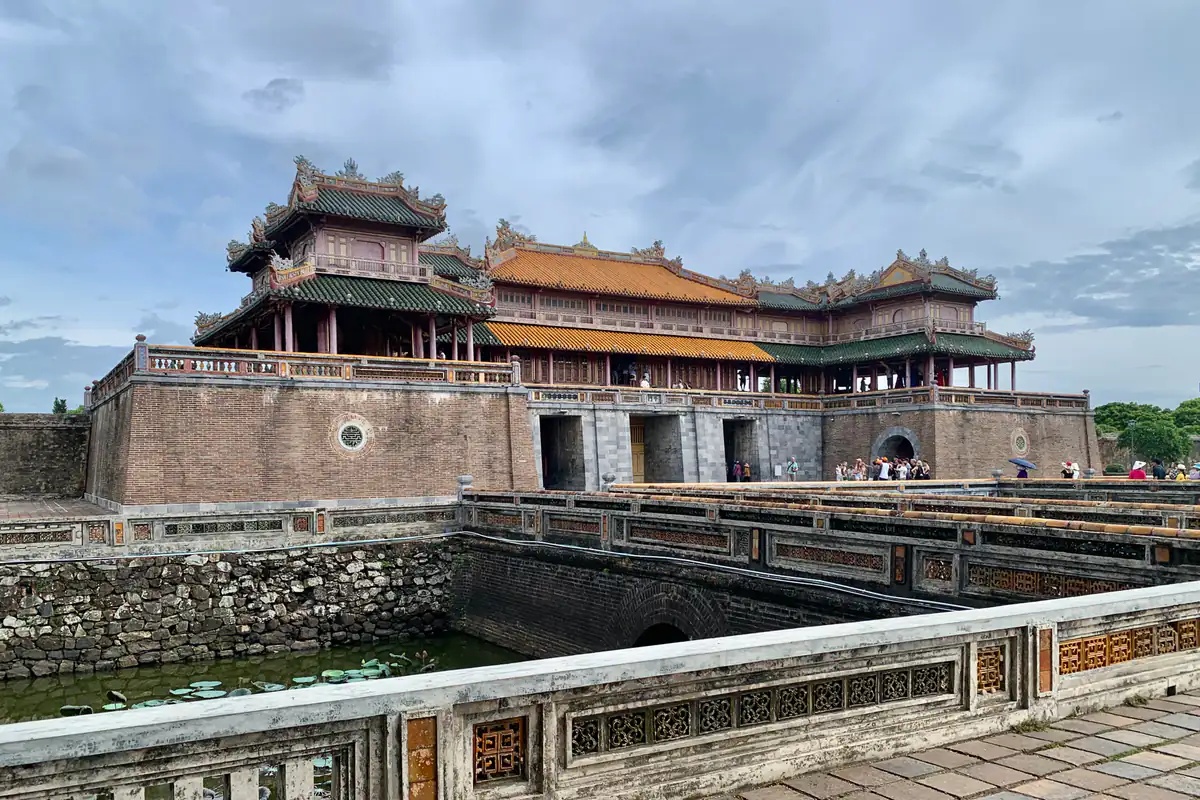
Photo: Chainwit.
The Perfume River splits Hue in two. The north bank holds the old Citadel, with the Imperial City, shady lanes and cafes tucked behind the walls, now in Phu Xuan (Phú Xuân) ward. The south bank has the train station, most hotels and the restaurants around Le Loi (Lê Lợi) Street, in Thuan Hoa (Thuận Hóa) ward. The royal tombs and Thien Mu Pagoda lie west and south along the river.
Hue rewards a slow pace. The sights are only a few kilometers apart, but each tends to hold you longer than planned, and midday is fiercely hot. We suggest monuments in the morning, a rest at noon, the river in the afternoon and food in the evening.
Things to do in Hue in one day, or two to three #
When time is short, drop the tombs first: they sit well out of town, and seeing all three takes a full day. With one day, keep the Imperial City for the morning, Thien Mu Pagoda for the afternoon and a breakfast of bun bo Hue (bún bò Huế) or com hen (cơm hến). To squeeze in one tomb, make it Tu Duc's, about 6 km from the Meridian Gate and easy in half a day, and skip the pagoda rather than cut the Imperial City short.
If two days still feel tight, drop Minh Mang, the farthest tomb, and keep Khai Dinh and Tu Duc. Dong Ba Market (chợ Đông Ba) and the evening boat with ca Hue (ca Huế), the city's traditional chamber singing, can go too; a walk along the river is enough for a night in Hue.
Overnight trains from Hanoi (Hà Nội) reach Hue in the morning, and the station is about 2.5 km from the Meridian Gate, so Hue is a natural place to break the long ride south for a night or two before moving on to Da Nang (Đà Nẵng) or Hoi An (Hội An), with its old town and nearby My Son (Mỹ Sơn).
Stay on the south bank, around Le Loi, for an easy evening walk to the river; pick a guesthouse inside the Citadel if you would rather cycle its quiet lanes early in the morning.
Hue Imperial City: tickets, combos and a morning visit #
The Imperial City holds more than a hundred structures, from the Meridian Gate and Thai Hoa Palace (điện Thái Hòa) to Dien Tho Residence (cung Diên Thọ) and The Mieu (Thế Miếu), the dynastic temple. Allow three unhurried hours. It opens at 6:30am from March 16 to October 15 and at 7am the rest of the year; arrive early with a hat, water and comfortable shoes, since the brick courtyards are wide, have little shade and get very hot by late morning.
A single Imperial City ticket is VND200,000 for adults. Combos pay off only if you will really visit every site: the 3-site combo (the Imperial City plus two tombs) is VND420,000 and the 4-site combo (the Imperial City plus Tu Duc, Khai Dinh and Minh Mang) is VND530,000, both valid for 2 days, against VND650,000 for the four bought separately. E-tickets from the Hue Monuments Conservation Center come as a QR code scanned at the gate; screenshot the code and your payment receipt.
The Hue Museum of Royal Antiquities, inside the Citadel near the Imperial City, sells its own VND50,000 ticket and is a good place to wait out a shower. After dark, the Imperial City opens only for some holidays and festivals, such as a free program of lights and performances during the Hue Festival; on other nights, head for the riverbanks and the streets around the walls.
Tu Duc, Khai Dinh or Minh Mang: which Hue tomb to visit #
Each of the three tombs has its own character. Tu Duc's tomb in Thuy Xuan (Thủy Xuân) ward, built in 1864-1867, is a garden with Luu Khiem (Lưu Khiêm) Lake, a pavilion over the water and paths under the trees, ideal if you like to linger. Khai Dinh's tomb, on Chau Chu (Châu Chữ) mountain in the same ward, is the smallest but the most elaborate, mixing Eastern and Western styles; at the top of a long staircase, the walls of Thien Dinh Palace (cung Thiên Định) are covered in porcelain and colored-glass mosaics. Minh Mang's tomb sits on the west bank of the Perfume River among ponds that fill with lotus in summer.
With time for one, we would pick Tu Duc for the setting or Khai Dinh for the decoration. For all three with the least backtracking, go Khai Dinh, then Minh Mang (about 4.5 km apart), and finish at Tu Duc on the way back. Khai Dinh is about 10 km from the Meridian Gate, Minh Mang about 14 km.
A car with a driver who waits is the least tiring option; agree on waiting time at each tomb first. Ride a motorbike only if you hold a license valid in Vietnam, wear a fastened helmet and take the hill roads slowly. The tombs are in hilly country where heavy rain can trigger landslides; postpone if warnings are issued.
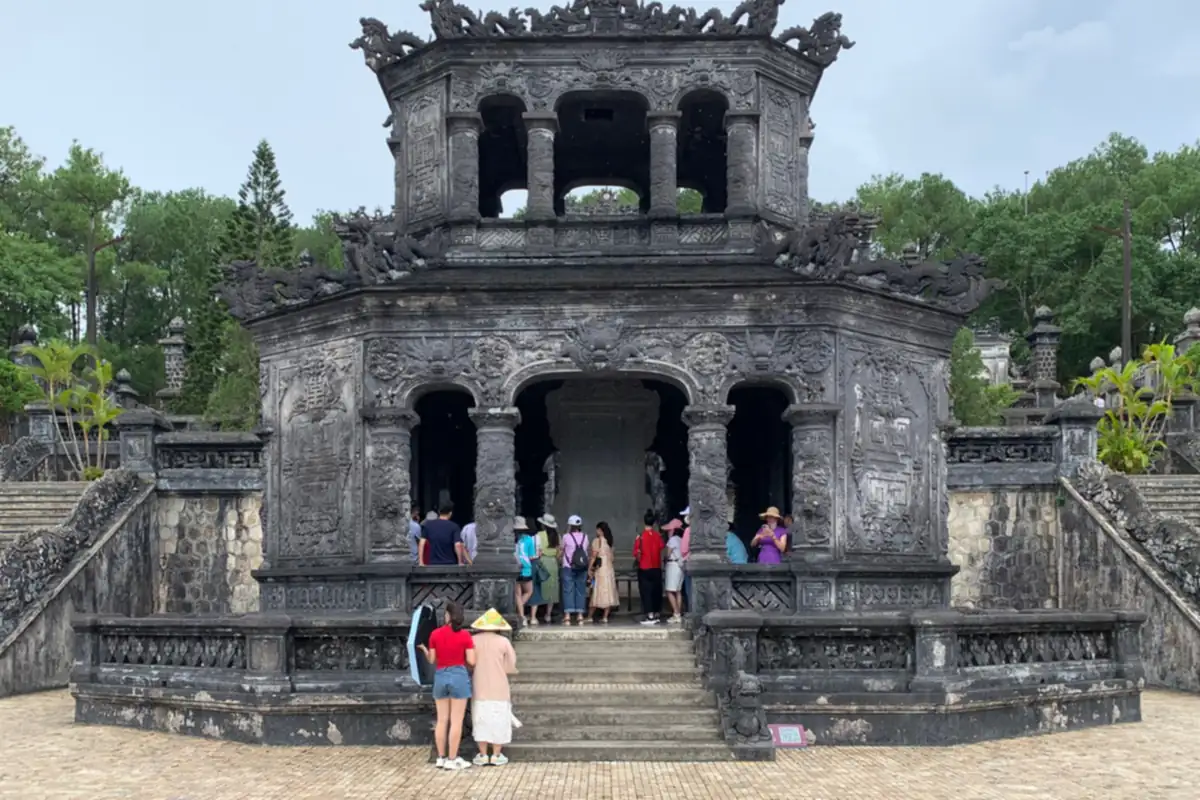
Photo: Chainwit.
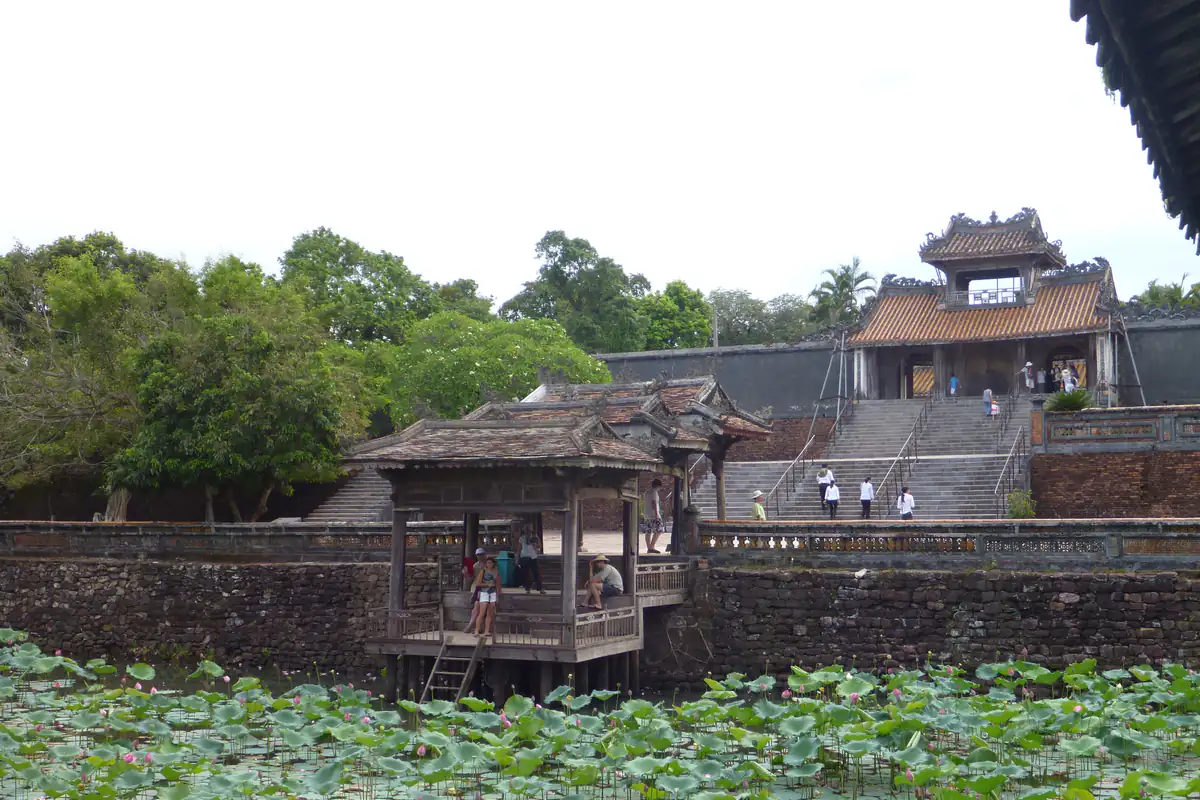
Photo: Nowic
Thien Mu Pagoda on Ha Khe (Hà Khê) Hill #
Thien Mu Pagoda stands about 4 km west of the Meridian Gate on Ha Khe Hill in Kim Long ward, looking straight over the Perfume River. Its seven-story Phuoc Duyen (Phước Duyên) Tower is the image everyone knows; behind it are the Dai Hung (Đại Hùng) main hall, gardens and a pine grove. Entry is free.
Go in the late afternoon, when the heat eases and the steps at the gate are in shade. This is a working monastery, so cover shoulders and knees, keep your voice down and ask before photographing people. The road from the center follows the north bank through Kim Long, an easy ride by bicycle or motorbike.
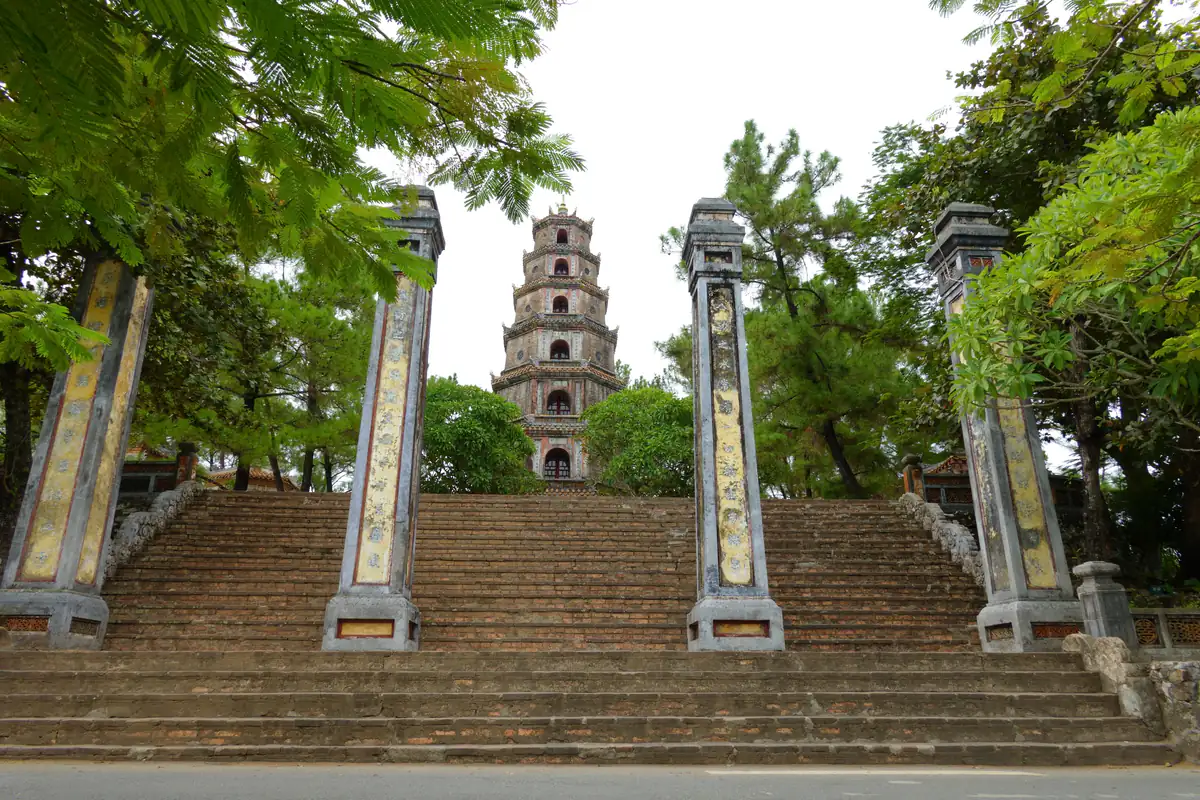
Photo: Gaodanielbo
Dragon boats and ca Hue on the Perfume River #
Dragon boats gather at Toa Kham (Tòa Khâm) pier on the south bank. By day they carry visitors upriver to Thien Mu Pagoda, Minh Mang's tomb and Hon Chen (Hòn Chén) Temple; in the evening they run ca Hue trips of about an hour, usually VND100,000-150,000 per person. Before you pay, ask whether the boat has its own singers or shares a group, what the price includes, how far you go and when you return.

Photo: P. Hughes
What to eat in Hue: bun bo, com hen, banh beo #
We suggest saving bun bo Hue for breakfast: thick round rice noodles in lemongrass broth, usually seasoned with mam ruoc (mắm ruốc, fermented shrimp paste), with pork knuckle, pork roll and herbs, a little different at every stall. Com hen is usually cold rice tossed with stir-fried baby clams, crackling, peanuts and herbs, with clam broth on the side. Banh beo (bánh bèo), banh nam (bánh nậm) and banh loc (bánh lọc) come in little saucers or banana-leaf parcels for an afternoon snack; banh khoai (bánh khoái), a crispy pancake, suits dinner.
Dong Ba Market, on the north bank near Truong Tien (Trường Tiền) Bridge, trades from morning to late afternoon. Hue food is spicy; ask for "ít cay" (less spicy) if you prefer it milder. Tell the cook if you have a food allergy: shrimp paste, fish sauce, clams and peanuts turn up in many dishes, dipping sauces included.
Crossing the Hai Van Pass to Da Nang and Hoi An #
Hue to Da Nang is about 100 km by road, Hoi An about 125 km. Cars usually take the tunnel; the pass road, with a stop at the top, adds roughly 12 km. Hai Van Gate (Hải Vân Quan), the old fort at the summit about 77 km from Hue, charges VND70,000 per person; children under 13 go free.
Each way to Da Nang shows the pass differently. The train hugs the mountainside, taking about 2 hours 30 minutes to 2 hours 45 minutes from Hue on SE trains; sit on the left heading south. With a private car, ask the driver to take the pass, stop at the top and detour to Lang Co (Lăng Cô); on a shared tour, ask beforehand whether it uses the pass or the tunnel. You cannot ride a motorbike through the tunnel; to skip the pass, use the service that carries motorbikes through the tunnel.
The pass has tight bends, trucks and buses on long descents, and cloud that can roll in without warning. Ride yourself only with a license valid in Vietnam and experience on mountain roads; riding pillion with a guide still means a proper helmet. In heavy rain, strong wind or landslide warnings, postpone, whether you ride yourself or with a guide: the pass road has been closed after landslides and fallen trees in storms. For October and November, see how to read flood warnings in Da Nang.
A Hue itinerary for 2 days #
| Time | Day 1 | Day 2 |
|---|---|---|
| Early morning | Bun bo for breakfast, Imperial City at opening | Khai Dinh's tomb while it is cool |
| Morning | Imperial City, three hours or more | Minh Mang's tomb |
| Midday | Lunch, rest | Lunch, rest |
| Afternoon | Thien Mu Pagoda, then a short dragon boat ride in calm weather, with life jackets on and no storm or flood warnings | Tu Duc's tomb on the way back, Dong Ba Market if you still have energy |
| Evening | Riverside walk, Truong Tien Bridge | Ca Hue on a boat (calm weather, life jackets on) |
On day 3, leave Hue in the morning so you cross the pass in good daylight.
Things to do in Hue: common questions #
What is the best time of year to visit Hue?
March and April are the most comfortable, and March is usually the driest month. May to August is hot, so start sightseeing early. October is the wettest, followed by November; outdoor plans then depend on each day's weather.
What can I do in Hue on a rainy day?
On an ordinary rainy day, the Imperial City still works if you follow the covered galleries, and so do the Museum of Royal Antiquities, a Citadel cafe and a snack crawl at Dong Ba Market. Leave the hillside tombs, boats and the Hai Van Pass for another day; if flood warnings are issued, stay somewhere safe.
How do tickets work for children?
Under-7s get in free. Ages 7 to 12 pay child rates: VND40,000 for the Imperial City, VND30,000 per tomb, VND80,000 for the 3-site combo and VND100,000 for the 4-site combo. At Hai Van Gate, children under 13 go free.
Can I go to the beach from Hue?
Thuan An (Thuận An) beach is about 15 km from the center and best in summer. Swim only inside buoyed areas while lifeguards are on duty and follow the flags; in the rainy, stormy season or when the sea is rough, stay out of the water.
Related posts
Road trips
Hanoi (Hà Nội) to Hoi An (Hội An) by Train: Times, Fares and the Transfer
Which overnight train crosses the Hai Van Pass in daylight, sleeper fares, the 30 km transfer from Da Nang Station, breaking the trip in Hue and keeping your things safe on board.
Places
Marble Mountains (Ngũ Hành Sơn), Da Nang (Đà Nẵng): Pagodas, Caves and the Climb Up Water Mountain
Two to three hours on Thuy Son for pagodas, caves and viewpoints, plus Am Phu Cave and the stone carvers at the foot of the mountain.
Places
Things to Do in Hoi An (Hội An): 1-Day and 2-3-Day Plans
Plan by trip length: the old town, tailors, basket boats, Tra Que, My Son and the Cham Islands, with prices, opening hours and a 2-day itinerary.