Famous Vietnamese Food: What to Eat in Each Region
The most famous Vietnamese food changes as you travel: pho (phở) in the north, bun bo Hue (bún bò Huế) and mi Quang (mì Quảng) in the center, broken rice and banh mi (bánh mì) in the south. Eat the local dish at the hour locals eat it, and you are rarely far from a good bowl.
Written by Tụi mình mê biểnPublished Updated
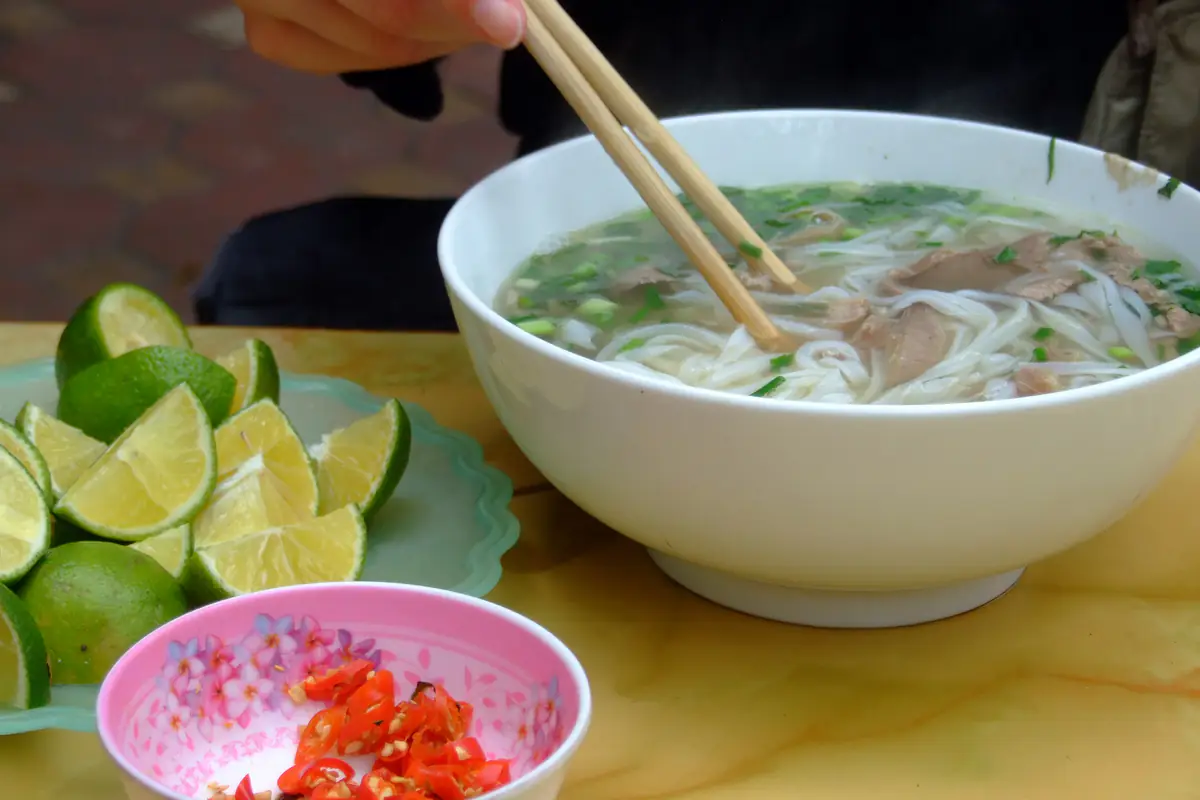
Photo: Codename5281
Early morning in Hanoi, steam rises from the pho pot at the end of the alley. At the same hour in Hue (Huế), a pot of bun bo wears a red slick of chili oil, and in Saigon (Sài Gòn) smoke from grilled pork chops drifts across the sidewalk. As a rough guide, northern food is clean and mild, central food bolder and spicier, and southern cooks lean sweeter and pile on more herbs.
Vietnamese dishes to try, region by region #
Grouped by region, not ranked. The last column suggests where to try each dish and when it is commonly served.
| Dish | Where to try it, when it is served |
|---|---|
| The north | |
| Pho | Hanoi; breakfast, some shops into the evening |
| Bun cha (bún chả) | Hanoi; lunch |
| Cha ca La Vong | Hanoi; lunch or dinner |
| Banh cuon (bánh cuốn) | Hanoi; breakfast |
| Central Vietnam | |
| Bun bo Hue | Hue; breakfast |
| Mi Quang | Da Nang (Đà Nẵng), Hoi An (Hội An); any meal |
| Cao lau (cao lầu) | Best tried in Hoi An |
| Banh xeo (bánh xèo), central style | Central coast |
| Bun cha ca (bún chả cá) | Nha Trang; breakfast |
| The south | |
| Com tam (cơm tấm) | Ho Chi Minh City (Thành phố Hồ Chí Minh); all day |
| Hu tieu (hủ tiếu) | Ho Chi Minh City, Mekong Delta; morning, evening |
| Banh mi | Everywhere; any time |
| Banh xeo, southern style | Ho Chi Minh City, Mekong Delta; afternoon, evening |
The north: pho, bun cha, cha ca and banh cuon #
In Hanoi, start with pho. Northern pho has a clear beef-bone broth scented with star anise and cinnamon, with fewer herbs than in the south. Some traditional beef pho shops offer only garlic vinegar, while lime goes with chicken pho. Dip a quay (quẩy), a fried dough stick, in the broth for a few seconds and eat it while still crisp.
Lunch belongs to bun cha: charcoal-grilled pork in a bowl of sweet, tangy dipping sauce, eaten with rice noodles and a basket of herbs.
Cha ca La Vong is a dish to linger over: fish, usually catfish (cá lăng), marinated with galangal, turmeric and fermented rice, grilled, then tossed with dill in a hot pan at your table and eaten with rice noodles, roasted peanuts, herbs and a little shrimp paste. With both peanuts and shrimp involved, mention any allergy first.
Banh cuon is breakfast: rice batter steamed thin on a cloth over a pot, rolled around minced pork and wood-ear mushroom, served with pork sausage and a light fish sauce dip. Pick a stall that steams to order.
Central Vietnam: bun bo Hue, mi Quang, cao lau and banh xeo #
Bun bo Hue is the boldest, spiciest noodle soup here. Beef bones simmer with lemongrass, the broth is seasoned with fermented shrimp paste, mam ruoc (mắm ruốc), and reddened with chili oil; the bowl holds beef, pork hock and sausage, and some shops add crab cakes. In Hue it is breakfast, so go early for the widest choice.
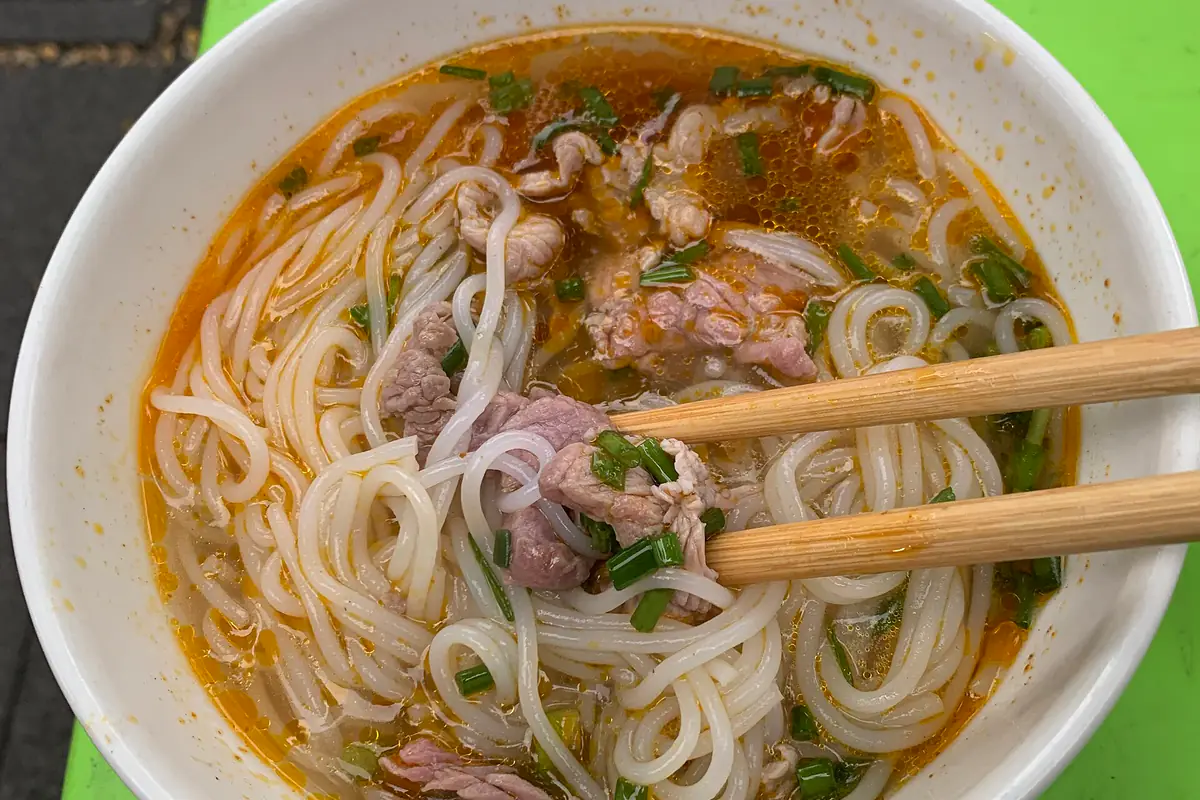
Photo: Chainwit.
Mi Quang in Da Nang and Hoi An has far less broth than pho: just a ladle of turmeric-yellow stock to coat wide rice noodles, topped with shrimp and pork, sometimes chicken or snakehead fish, and roasted peanuts (with a peanut allergy, ask for none when you order). Locals break a sesame rice cracker over the bowl, add herbs and shredded banana blossom, and eat it at any meal.
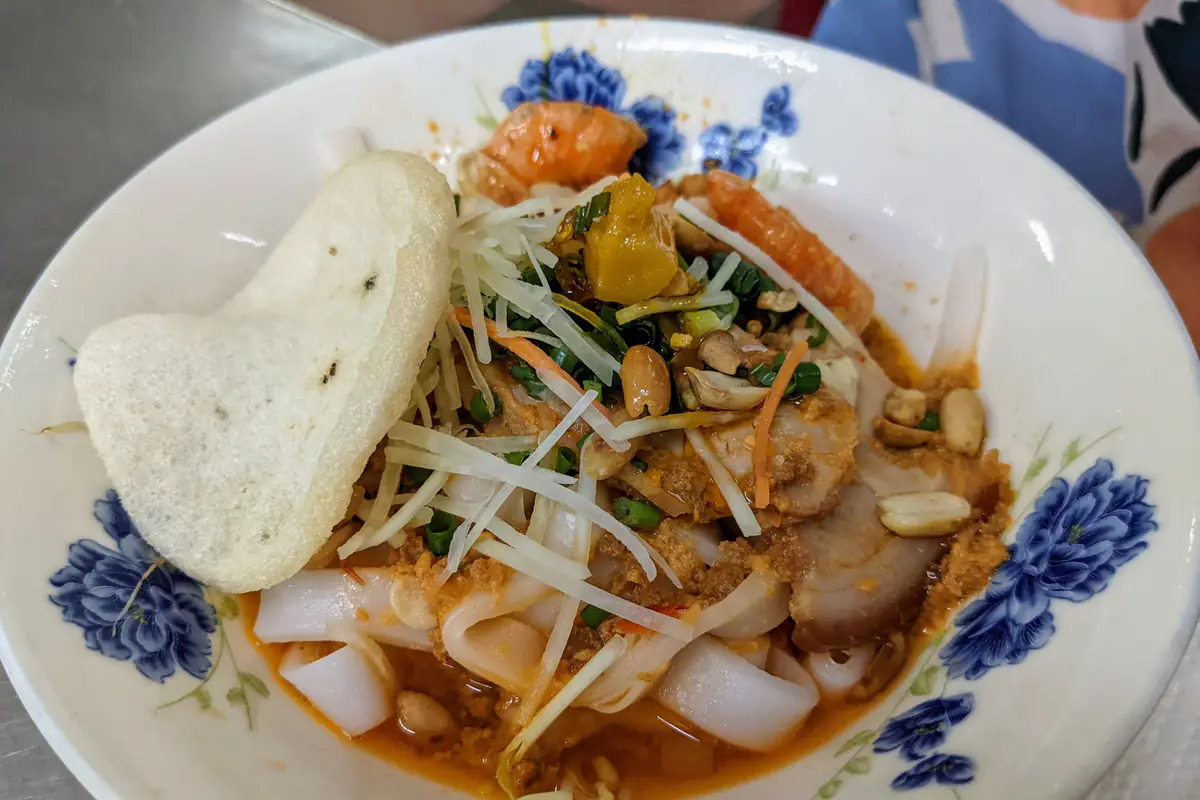
Photo: Jpatokal
Cao lau is a Hoi An specialty: thick, chewy noodles with char siu pork, herbs, crispy pork crackling and a small ladle of spiced broth. Local lore credits their texture to water from the old Ba Le (Bá Lễ) well. With two days in Hoi An, we suggest one meal of cao lau and one of mi Quang: they look alike but taste quite different.
Central-style banh xeo are small, thin crepes, rolled with herbs and dipped in fish sauce. In Nha Trang they are often made with fresh squid; an afternoon of squid crepes and banh can (bánh căn) is a good start on the city's food, along with a breakfast of fried and steamed fish cake in fish broth and grilled pork you roll in rice paper.
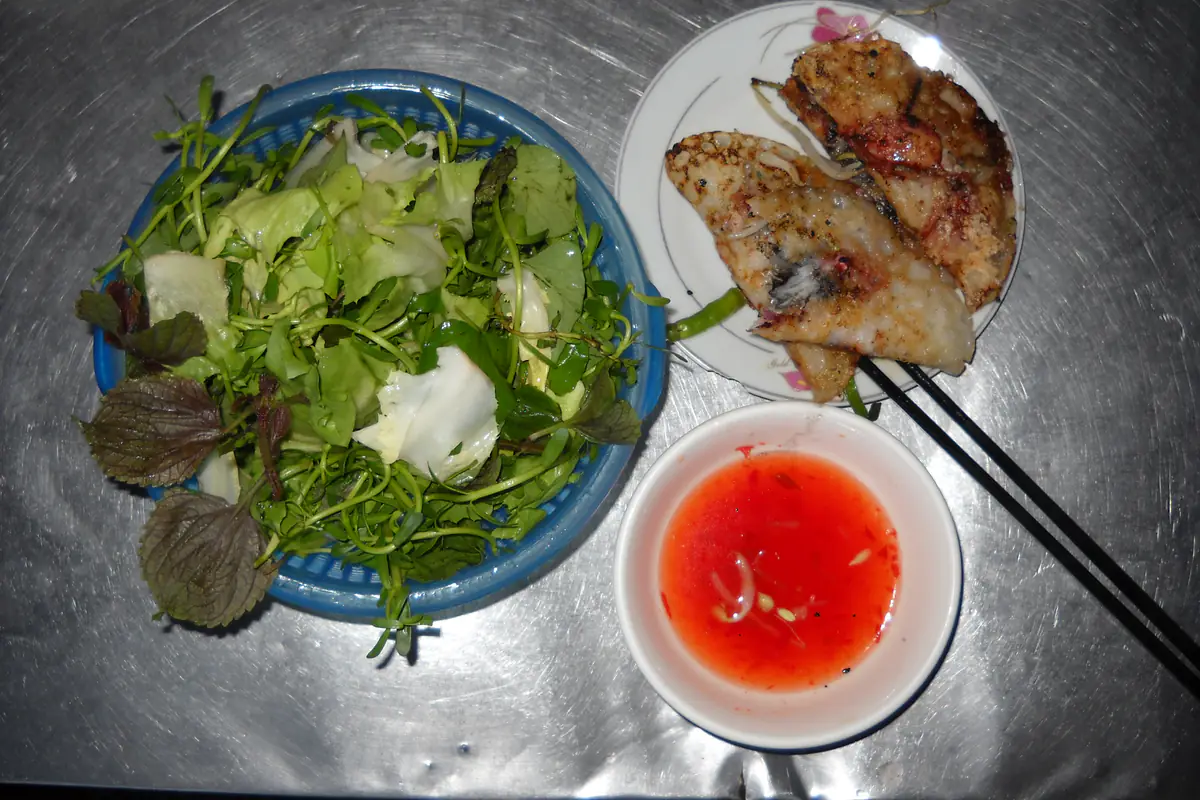
Photo: ASM~viwiki
The south: com tam, hu tieu, banh mi and banh xeo #
Com tam is Saigon's filling plate: broken rice with a charcoal-grilled pork chop, shredded pork skin and egg meatloaf, sometimes a fried egg, finished with scallion oil, pickles and a small bowl of sweet fish sauce.
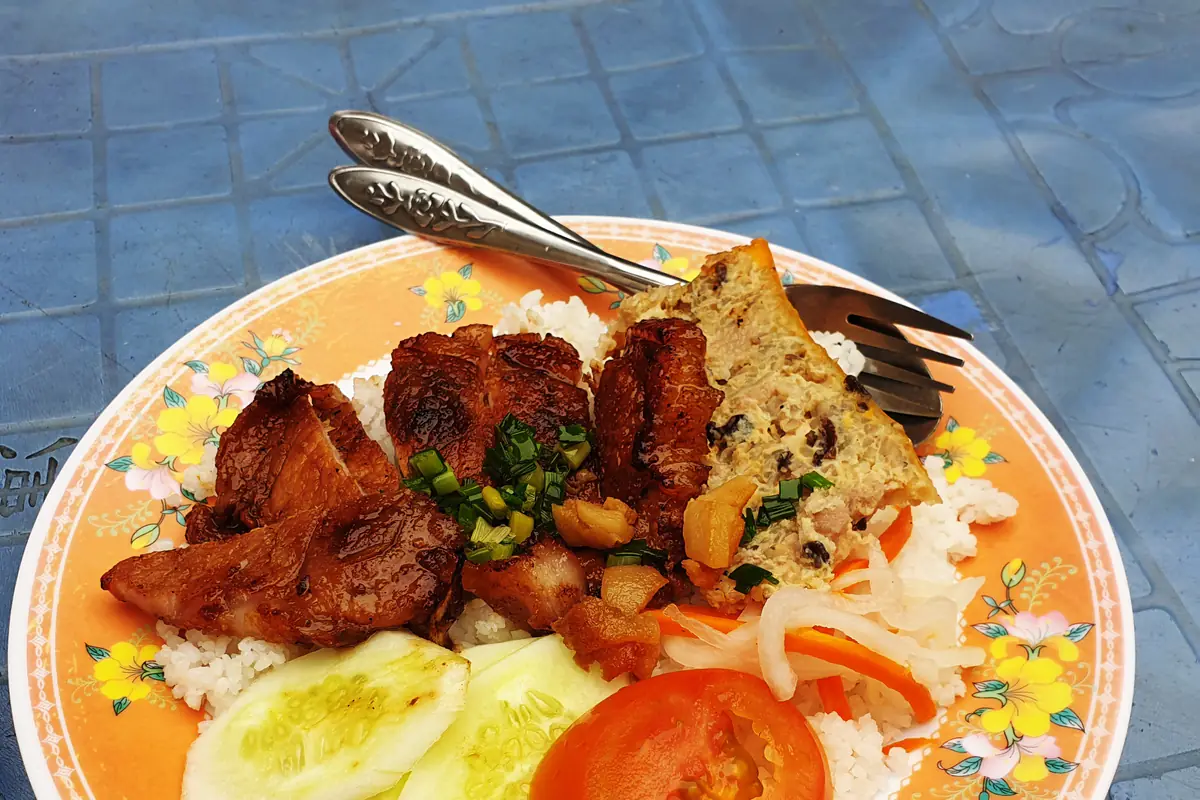
Photo: Phương Huy
Hu tieu comes as a soup, or dry with the broth on the side. Hu tieu Nam Vang adds pork, liver, shrimp, a quail egg and sometimes cubes of pork blood; if offal is not for you, ask them to leave it out when you order.
Southern banh mi carry more herbs and pickles than Hanoi ones. It makes a convenient breakfast before a bus journey; eat it promptly rather than saving it for hours.
Southern banh xeo is a crisp crepe the size of a large plate, with coconut milk and turmeric in the batter and shrimp, pork belly and bean sprouts inside. It is usually cut up, wrapped in lettuce, mustard greens and herbs, and dipped in sweet-sour fish sauce, and it is best straight from the pan. Between meals, a glass of bac xiu (bạc xỉu) or iced milk coffee is how Saigon takes a break.
Vietnamese food for first timers: what to order, how to eat #
For your first Vietnamese meals, we suggest pho, com tam, banh mi or banh xeo. Banh mi and banh xeo usually come with raw herbs and pickles; to follow the CDC advice above, ask for them to be left out. Save bun bo Hue and cha ca with shrimp paste for a few days later, once fish sauce no longer surprises you.
Many shops sell a single dish, so you only need to say how many bowls and which meat: rare beef (bò tái), well-done beef (bò chín) or chicken (gà). The table usually holds lime, fresh chili, chili sauce, fish sauce or garlic vinegar. Taste the broth first and add a little at a time; Vietnamese bird's eye chilies are hot, and one or two slices are plenty to start.
What a bowl or a plate costs #
Each line is one shop or area on the date it was reported; where there is no price list, ask before you order.
| Dish | Typical price | Where, when |
|---|---|---|
| Beef pho | VND50,000-65,000 a bowl | One shop in Dong Da (Đống Đa), Hanoi (July 2026) |
| Bun cha | VND40,000-50,000 a serving | Neighborhood shop, Hanoi (April 2026) |
| Bun bo Hue | VND40,000-70,000 a bowl | One long-running shop in Hue (August 2026) |
| Mi Quang | Mostly under VND45,000 a bowl | Da Nang, per the MICHELIN Guide (April 2025) |
| Banh mi | VND20,000-25,000 from a street cart; VND73,000 at one famous shop | Ho Chi Minh City (July 2025) |
Prices exclude drinks and extras such as fried dough sticks or eggs. According to Ngoi Sao (Ngôi Sao) newspaper (July 2026), a VND30,000 bowl of noodle soup had all but disappeared in Hanoi.
Vegetarian Vietnamese food: chay restaurants and pagoda meals #
Many Buddhist families eat vegetarian on the 1st and 15th days of the lunar month, on Buddhist holidays and on death anniversaries, so in big cities a "cơm chay" (vegetarian rice) or "quán chay" (vegetarian eatery) sign is easy to spot, with meat-free pho, noodle soups and mi Quang made from tofu, mushrooms and vegetables. Those days can get busy, so go early. At ordinary restaurants, a dish labeled "chay" may still contain fish sauce, so ask about the broth and the dip. Some pagodas serve community vegetarian meals; check whether visitors are welcome before planning a visit around one.
Allergies: peanuts, shellfish and fish sauce #
Fish sauce, nuoc mam (nước mắm), is made from fish and may be used in dipping sauces and broths, including bun bo Hue and mi Quang, so check the ingredients of each dish if you have a fish allergy, vegetarian ones at ordinary restaurants included. Shrimp and crab turn up in shrimp paste, crab cakes and as shrimp in banh xeo, mi Quang and hu tieu Nam Vang. Peanuts top mi Quang, come with cha ca, and may appear in other dishes or dips depending on the shop. Eggs come in the egg meatloaf and fried egg of com tam and the quail egg in hu tieu.
Carry a few lines in Vietnamese to show staff: "Tôi bị dị ứng đậu phộng" (I am allergic to peanuts), "Không tôm, không mắm tôm, mắm ruốc" (no shrimp, no shrimp paste), "Không nước mắm" (no fish sauce). If a shop cannot confirm the ingredients, choose another dish. If you have had a severe reaction before, talk to your doctor before the trip about the medicines to bring.
Vietnamese food FAQ #
Which Vietnamese dishes are not spicy, for kids or cautious eaters?
Pho, com tam, banh cuon and hu tieu are usually mild, with chili served on the side. Bun bo Hue comes spicy in the broth, so ask for less chili oil or choose another dish.
Can I take food back to my hotel?
Yes, but dishes with meat, fish or broth are perishable: the US CDC advises not leaving them out for more than 2 hours, or 1 hour above 32°C (90°F), including travel time. Ask the shop to pack the broth separately, eat soon and refrigerate leftovers.
Related posts
Food
Vietnamese Coffee: Drinks to Try by Region, How to Order and What It Costs
Egg coffee in Hanoi, salt coffee in Hue, iced milk coffee and bac xiu in Saigon: what is in the glass, how to order, what it costs and how to take coffee home.
Food
Bun Cha (Bún Chả) in Hanoi (Hà Nội): What It Is, How to Eat It and Where to Go
What comes in a serving of bun cha, how to eat it, what it costs, which Hanoi places are in the MICHELIN Guide and the story of the Obama combo.
Food
Nha Trang Fish Cake Noodle Soup (Bún Chả Cá): Where to Eat It and What to Order
Where to eat bun cha ca in Nha Trang, what is in the bowl, how it compares with bun sua and how to take fish cake home.